What's New Under The Sun
World Sundial Day - March 20, 2026
Monday, 09 March 2026 15:10
Building on the success of the 2025 inaugural event celebrating world sundial day on March 20th, 2026. This global online gathering celebrates sundials, timekeeping, astronomy, history, art, mathematics, craftsmanship, and cultural heritage across the world.
Want to hear engaging talks about sundials? Learn about projection sundials, bifilar sundials, and simplified vertical inclining and...
NASS Conference Coming to Louisville, KY - June 25-28, 2026
Thursday, 22 January 2026 18:30
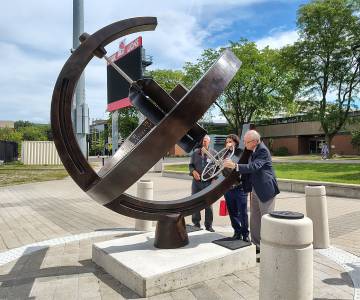
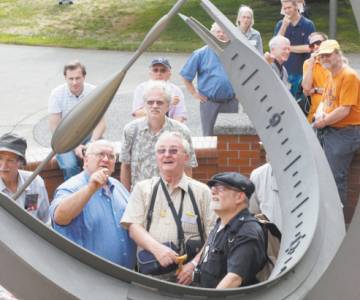
UPDATE: We will have a special tour of the Kentucky Viet Nam Memorial Sundial. See the attachment about the construction of this wonderful memorial.
Get ready to travel. This year the 31th NASS annual conference will be held in Louisville, KY at the Hyatt Regency Hotel June 25th - June 28th. The conference starts Thursday June 25th at 4:30pm with an opening reception, introductions,...
Madison Historic Dial Returns
Monday, 13 October 2025 22:49
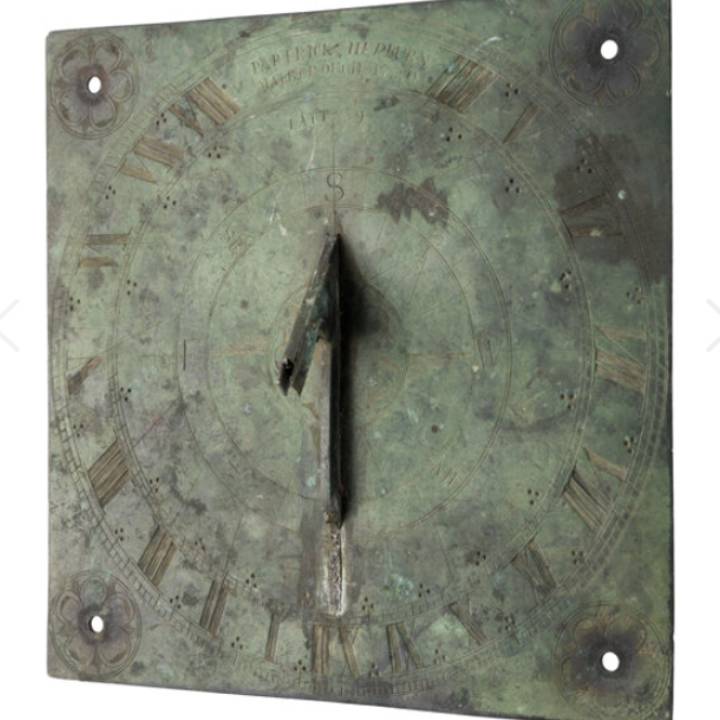
On October 4, 2025 Madison Historical Society of Ohio was able to have their sundial returned after 32 years, when in 1993 it was moved to the lawn of Lake County Courthouse to reduce the chance of vandalism. The sundial was originally placed at Madison Home 100 years ago on Saturday, October 24, 1925 during a conference of the Women's Relief Society. From 1904 to 1962 the state ran this...
Elements of Dialing Course - 2025
Monday, 15 September 2025 19:42
NASS is pleased to announce the upcoming fifth instance of Elements of Dialing, our introductory course about sundials, their history, and the science that makes them work. The free 12-lesson course, intended for those are new to sundialing, runs from 27 October 2025 until 26 April 2026. The course instructor is Robert Kellogg, NASS Vice President and Sundial Registrar. Bob will be...
Sun Queen of World War II
Thursday, 11 September 2025 23:11
A Hungarian born American scientist, Mária Telkes (1900-1995), was called "The Sun Queen" and among other honors, was postmousthly inducted into the National Inventors Hall of Fame. She lived to 95 and for most of her life developed solar power in a variety of forms.
Trained as a biophysicist, she worked for Westinghouse Electrical and Manufacturing Company in Pittsburgh, PA, where she...
2025 Conference -Ottawa
Thursday, 28 August 2025 23:25
The annual NASS Conference was held 7-10 August, 2025 in Ottawa. As usual, the conference began late Thursday afternoon with an introduction social and a "grab bag give away", taking your chances with tickets to win the bag's prize. Will Grant was the final winner of the Walton Double Planar Polar Sundial, but Paul Ulbrich beat the statistic odds and won this prize three times,...
Prosciutto di Portici Sundial's Owner
Tuesday, 10 June 2025 18:51
Prosciutto di Portici (Ham) Sundial
Photo: Getty Images
The Prosciutto di Portici Sundial, more often called the Portici Ham Sundial, dates from the first century somewhere between 8 BCE to 79 CE. This small silvered bronze dial was uncovered on 11 June, 1755 in the ruins of Herculaneum (current day Portici) in the "Villa of the Papyri", buried in...
Hamilton Dial Dedicated
Friday, 06 June 2025 21:01
Sundial dedication May 31, 2025. At left is Kathleen Stuckey Fox, with the City Proclamation presented by Mayor Pat Moeller and City Council on-lookers Carla Fiehrer and Susan Vaughn offering congratulations.
On May 31, 2025 at 1pm, the Hamilton, Ohio, sundial (NASS Sundial Registry #1109) was re-dedicated in Monument Park. Originally dedicated in 1941 to the...
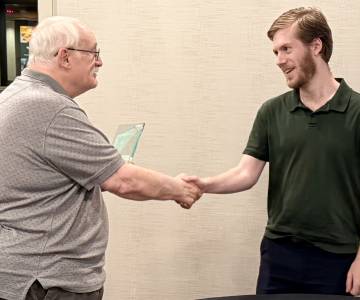
Frans Maes Received a Royal Decoration
Monday, 24 March 2025 21:33
Several years ago Frans decided to write the course on sundials that included self assessment questions to force students not only to read the text, but to internalize the concepts. And a final submittal question "not necessarily a difficult question, but: no answer, no new lesson." Thus Frans Maes began writing lessons and sending them out to students.
NASS has now used his material to create...
Pros and Cons of Daylight Savings Time
Monday, 24 March 2025 15:37
In a 24 March 2025 article from the on-line Science Advisor (American Association for the Advancement of Science) Phie Jacobs summarizes the "great debate" of the yearly shift from standard time to daylight savings time. In January 2025 the US Senate introduced the Sunshine Protection Act to permanently have daylight savings time year round. Certainly 54% of Americans do not like the...
Native American Moon Alignment Ring
Friday, 21 March 2025 19:26
Perhaps the most famous alignment circle in the United States is the Cahokia Woodhenge near St. Louis constructed between 700-1400 CE by Cahokia Indigenous native Americans. But there were an estimated 10,000 other earthen mounds that once were scatter across the mid-west..
In an article from Atlas Obscura (https://www.atlasobscura.com/articles/octagon-earthworks-ohio) by Olivia Young on March...
Hamilton Dial under Restoration
Friday, 21 March 2025 18:37
The Hamilton dial is in the restorative care of Jarrett and Celene Hawkins (Hawkins & Hawkins Custom, LLC in Cincinnati Ohio https://www.studio-hawkins.com/) in preparation for the dial's dedication on Saturday, May 31, 2025.
The face of the Hamilton Grand Army of the Republic (GAR) sundial has been cleaned and bead-blasted showing the dial as it was cast 84 years ago. In the process,...
US Postal Service to Issue Eclipse Stamp
- Details
- Hits: 15063
The 2017 August 21st solar eclipse will be commemorated by the US Postal Service with a unique thermochromic ink Forever Stamps: the stamp shows the total Eclipse of the Sun with its corona blocked by a black disk of the moon. However, using the body heat of your thumb or fingers the eclipse image will reveal an underlying image of the moon. The image reverts back to the eclipse once it cools. Fred Espenak, "Mr. Eclipse" a retired NASA astrophysicist, took the photograph of both the eclipse (from Jalu, Libya on March 29, 2006) and the full moon.
The USPS states that June 20, 1:30 p.m. MT will be theFirst-Day-of-Issue ceremony, taking place at the Art Museum of the University of Wyoming (UW) in Laramie. The University is celebrating the summer solstice on June 20. Prior to the stamp issuance, visitors are encouraged to arrive at UW's Art Museum's Rotunda at 11:30 a.m. to witness a unique architectural feature at noon when a single beam of sunlight shines from down on a silver dollar embedded in the floor, marking noon on the summer solstice,
The Total Eclipse of the Sun Forever Stamps may be pre-ordered at usps.com/shop in early June for delivery following the June 20 nationwide issuance. The back of the stamp pane provides a map of the eclipse path and times it appears at cities across the US.

Read more at: NASA Eclipse and for observing tips http://www.mreclipse.com/SEphoto/SEphoto.html
Tour of Time
- Details
- Hits: 14220
At the Grolier Club on the Upper East Side of Manhattan is a massive exhibit On Time: The Quest for Precision curated by Bruce Bradley. The exhibit presents the progress of timekeeping over six centuries through 86 rare books from the Linda Hall Library of Science, Engineering & Technology.
![]()
1624 La pratique et demonstration des horloges solaires
|
Journalist Allison Meier of Hyperallergic.com describes a number of books on display such as "German cartographer Sebastian Münster’s 1533 Horologiographia, the first book devoted to sundials, with woodcuts attributed to Hans Holbein the Younger." As shown in her photo, "French engineer Salomon de Caus’s 1624 La pratique et demonstration des horloges solaires has embedded pop-ups to make the workings of its sundials easier to replicate."
The scope of "On Time" stretches from sundials, to water clocks, mechanical clocks and even a Pilkington & Gibbs Heliochronometer, ending with our latest atomic clocks. The display flirts with the possible. While Benjamin Franklin may have suggested using hourly time-telling canon in the 18th century, Athanasius Kircher proposed a fanciful firing sundial a century earlier in his 1646 Ars magna lucis et umbrae in decem libros digesta. His bowl-shaped sundial holds gunpowder at the hours that is ignited by the rays of the sun from a lens. In turn the firing gunpowder triggers hammers to toll hourly bells. If one thinks about this for a moment, Kircher's proposal is as unrealistic as Franklin's. The change in solar declination creates problems for proper placement of the gunpowder, let alone directing the ignition to trigger hammers.
Allison observes that "These manuscripts affirm the centuries of shared ideas that give our modern timekeeping devices their precision." On Time: The Quest for Precision" continues through November 19, 2016.
Read more at: http://hyperallergic.com/327958/on-time-grolier-club-manhattan/
Sundials and Timely Ceremonies
- Details
- Hits: 14452
What do Omega Psi Phi fraternity of Howard University Washington DC, Merton College in Oxford, Nashotah House Theological Seminary in Wisconsin, and Lewis Carroll's poem Jabberwocky all have in common? Dancing and ceremonies around a sundial! In Carroll's poem of 1885 "the slithy toves did gyre and gimble in the wabe" and as Alice explains to Humpty Dumpty, “Toves are curious creatures that are something like badgers, something like lizards, and something like corkscrews. They make their nests under sun-dials and live on cheese." and “Wabe is the grass-plot round a sun-dial. It is called like that because it goes a long way before it, and a long way behind it. And a long way beyond it on each side."
At Howard University in the center of the main campus quadrangle is a bronze sundial on a 3-foot fluted limestone pedestal, gifted in 1929 to the university in honor of Benjamin Banneker, surveyor of the city of Washington DC, clockmaker, and sundialist.
...until the last syllable of recorded time
- Details
- Hits: 11752
With all due respects to Shakespeare, time will always be with us, and signifies quite a lot. The Harvard-Smithsonian Center for Astrophysics is organizing a symposium dedicated to Time and Culture to be held 5-9 June 2016 at Harvard's Northwest Lab. According to the symposium organizers:
"The symposium aims to set the stage for future timekeeping standards, infrastructure, and engineering best practices for astronomers and the broader society. At the same time the program will be cognizant of the rich history from Harrison's chronometer to today's atomic clocks and pulsar observations. The theoreticians and engineers of time will be brought together with the educators and historians of science, enriching the understanding of time among both experts and the public."
The definition of the second has changed several times over the last 40 years and likely will change again before the end of this decade. Should timekeeping be decoupled from the rotation of the earth? We already abstract time with zone time (such as Eastern Standard Time) and minipulate it to fit our activities (using Eastern Daylight Saving Time). We no longer worry about the moment of sunrise or sunset, rather that we go to work at 9:00AM or have a class that lasts from 10:00-10:50AM. Indeed, "ante and post meridian" may be obsolete.
"The future of timekeeping is evolving with the development of optical frequency standars, the consideration of high-order relativistic effects, and the challenges of distributing trusted timescales at even higher preicision....A closer look at time in astronomy and other sciences, as a defining element of modern civilization, is needed." Read more and register for the symposium at: http://timesymposium.org
Greenwich Globe
- Details
- Hits: 18955
![]() |
Goikhman explains: " The Greenwich Globe's shape was generated by an algorithm that treated time as physical matter. Each additional hour is represented through a constant degree of elevation and a 15o angle bend. The elevation based map projections gives easy-to-read shape to the complex man-made system of time-zones. It also operates as a sundial, a play on the now familiar row of world time clocks. The shadow it casts on a wall is meant to be read as a world watch. Each spike in the shadow shows the local time at a corresponding geographical region."
A History of the Sky
- Details
- Hits: 17919

Kevin Murphy, artist and photographer, set up a time-lapse camera on the roof of the San Francisco Exploratorium to record the sky every 10 seconds, 24 hours per day for an entire year. The camera points due north at and elevation of 45 degrees, which means that you won’t see any dramatic sunrise or sunset, nor will you see a burning image of the sun. Even with the wide-angle lens, the sun is always kept just out of view. But what a wonderful view of the sky: Look closely at the video and you’ll see moving clouds, fog, rain, and differing colors of the sky.
Most stunning is the changing length of the day. Summer morning twilight begins about 4:10am (Pacific Standard Time) and evening twilight ends about 8:10pm, but you must be patient for the winter sky to appear. Winter morning twilight begins about 6:50am (PST) and evening twilight ends about 5:30pm. (There’s a small running clock in the bottom right corner to chart your progress). You’ll see the dramatic difference between summer and winter with days in darkness patiently waiting their turn at sunrise and conversely, the fast quenching of the blue sky into darkness well before the summer frames show any sign of paling.
Each frame is digitally photographed at 1024x768 pixels, that with compression, requires about half a terabyte storage per year. Kevin Murphy has been creative with the sky display: Thumbnail videos of each day of the year are collectively represented in a tiled mosaic 20 days wide by 18 days tall, showing 360 days of sky all at once. The images are arranged chronologically, and are synchronized by time of day, beginning before summer sunrise. Time is compressed in playback at 24 frames/second so that each second represents 4 minutes of time.
This is still a work still in progress: As the camera on the Exploratorium roof continues to collect images of the sky, they will be integrated into the daily montage. Therefore the video will vary from day to day, always displaying the most recent 365 days.
Visit http://www.murphlab.com/hsky/ for more information. Below is his video. It’s best played in full-screen HD resolution. Click the middle arrow to start, then click the bottom right frame box.
Virtual Art for Inventor of Standard Time
- Details
- Hits: 16764
A new sundial project called “Meantime in Greenwich” opened on “Dingle Day” August 6th in Sir Sandford Fleming Park (affectionately known as “Dingle Park”) located in the Halifax Regional Municipality of Nova Scotia. Media artist David Clark created a series of 24 horizontal sundials that surround the Memorial (Dingle) Tower, a site that once had been Fleming's summer home. Visitors to the public exhibit can download a free app onto their phone or iPad and hear an audio story when they approach each sundial. For iPhone users, aiming its camera at the sundial triggers a 3D object to appear on the screen. As Clark describes it, “Each sundial becomes a pedestal for virtual reality. Everybody becomes their own cinema.”
2012 Transit of Venus
- Details
- Hits: 14902
|
|
NASA has taken outstanding video of the June 6th 2012 transit of Venus. Images were recorded by the NASA Solar Dynamics Observatory Satellite that records the sun's surface and corona at a number of visible light and ultraviolet wavelengths. [See sdo.gsfc.nasa.gov] These images showing the 2012 transit of Venus were recorded at a wavelength of 171 Angstroms (AIA 171) (Extreme Ultraviolet). This channel is especially good at showing coronal loops - the arcs extending off of the Sun where plasma moves along magnetic field lines. The brightest spots seen here are locations where the magnetic field near the surface is exceptionally strong.
NASA video source and images may be found at http://svs.gsfc.nasa.gov/vis/a010000/a010900/a010996/index.html
Eclipse Sundial For May 20th, 2012
- Details
- Hits: 14727
Don’t miss the Solar Eclipse this Sunday, May 20th. Times of the eclipse can be found at http://eclipse.gsfc.nasa.gov/OH/OHtables/OH2012-Tab02.pdf
For those of you in the San Francisco – San Mateo California area, Bill Gottesman, NASS dialist, has created an “eclipse clock”, a new type of paper sundial made specifically for the partial solar. You need a simple pin-hole projector (a card with a small hole in it) to cast a shadow of the eclipsed sun. The angle of the moon’s shadow tells accurate time (at least for San Mateo California). Bill will discuss how he made this dial at the NASS Sundial Conference in Asheville this August. Come find out how he did it.
Site Search
Sundial Question?
Current Sun
Civil = Sundial + EoT + dLon
where dLon is (4xNr Degrees W. of Time Zone
Select Sundials by State/Province
Who's Online
We have 592 guests and no members online