Seattle - Sundial Capital of North America Print
Posted: Thursday, 16 May 2013 22:37

Read The Seattle Times article of May 14, 2013: http://seattletimes.com/html/localnews/2020985468_sundialxml.html

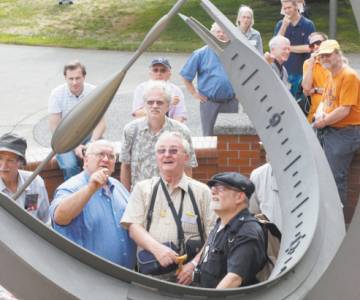
nass_news_2013_may_Sullivan_DialIn the May 14, 2013 edition of The Seattle Times University of Washington professor Woody Sullivan was honored as ‘Mr. Sundial’ for his persistence in declaring Seattle as the Sundial Capital of North America. Dr. Sullivan has worked on more than a dozen dials in Seattle, including the large 20x30 foot vertical dial on southwest wall of the Physics and Astronomy building at UW and the elegant 11x17 foot reflection sundial painted on the ceiling of his garage at N 47° 41.232, W 122° 21.562.  A small circular mirror outside the south facing window reflects a spot of light onto the ceiling.

The reflection sundial was a labor of love taking over 3 years to create.  Woody marked over 700 locations on the ceiling that allowed him to draw the local solar time, dates, hours of daylight, solar azimuth and altitude, analemma, and even hours to dawn.  And being a radio astronomer, he marked the transit sidereal time for two radio sources.  The dial was painted with marvelous beauty by a local mural artist, Jim Noonan.  The sundial is very personal to Woody, showing time marks for the date he married to the birthdays of himself, his wife, and two daughters.  The zodiac painted along the ecliptic has a local touch, representing Pisces by a pair of sockeye; Cancer by a Dungeness crab; and Capricorn as a mountain goat. There is even a compass rose.

nass_news_2013_may_UW_dialFred Sawyer, president of the North American Sundial Society (NASS) is quoted by Erik Lacitis, Seattle Times staff reporter, saying “it’s likely true that Sullivan’s garage sundial is one of the best in North America.”  When the NASS visited Seattle for the 2011 annual sundial conference, they visited Woody’s Reflection Dial and a marker was added to it for the date and time of itsofficial dial dedication held on Saturday 22 August 2011. “We toasted the sundial with an appropriate wine, ‘Wehlener Sonnenuhr’ by Joh. Hos. Prum, the fine Mosel Kabinett from the German vineyard with a large vertical sundial.” said Roger Bailey, the society’s secretary.

Among Dr. Sullivan’s accomplishments in the world of sundials began in the early 1990’s when the University of Washington’s Physics and Astronomy Building was being designed.  He suggested a large vertical (southwest declining) sundial.  The dial was completed in 1994 and Woody was hooked. He also helped design sundials used on the Mars exploration rovers Sprit and Opportunity that landed ion the Martian surface in 2004.  A campaign to build sundials all around our world ensued with the motto “Two Worlds One Sun”.  [photos from NASS]

Last Updated on Tuesday, 21 May 2013 21:44
 
Building Gone - Dial Lives On Print
Posted: Thursday, 18 April 2013 10:35

nass_news_2013_apr_Bracewell_Dial1In 1995 Professor Emeritus Bracewell designed a vertical declining dial for the south face of the Terman Engineering Building at his Stanford University home campus in Palo Alto. But the building was torn down in 2011 and by March 2012 nothing but landscaping of the new Terman Park remained.  Fortunately Prof. Ronald Bracewell’s sundial once again casts its solar time on the south wall of the Stanford Jen-Hsun Huang Engineering Center.  Both the Huang and old Terman building have similar south-south-west alignments allowing the dial to be remounted without adjustment. [http://library.stanford.edu/blogs/stanford-libraries-blog/2013/04/sundial-returns-engineering-center].

[photo courtesy of Kathleen Gust, Terman Engineering Library, Stanford Univ]

Bracewell described the sundial in the March 1997 issue of Stanford’s Civil Engineering Newsletter [http://www-ce.stanford.edu/Newsletter/archive/CENL0397.PDF ].  It is a vertical declining dial 15 degrees to the west, approximately 72 x 80 cm in size and made from aluminum  In a plaque prepared by Bracewell and installed beneath the sundial, he states that his dial was modeled after the vertical dials that still faintly adorn the Tower of the Agora in Athens.  The Tower of Agora, also known as the Tower of the Winds, was designed by Andronikos of Kyrrhos, and built in the early Roman period ~1st century BC.

Instead of a typical gnomon, Bracewell chose to use an oculus: a disc with a central hole.  Standing 8 cm in front of the dial, the disc creates a shadow with a bright dot of sunlight in the center for telling both time and season.  The hour lines are offset by 2 min 40 sec to account for the longitude of the Stanford campus and the hour lines themselves are laid out not as straight lines, but as analemma curves (the figure 8 pattern of the sun’s seasonal movement), with spring colored in green, summer in red, autumn in orange, and winter in blue.  The analemma corrects for the “Equation of Time” allowing Bracewell to create an accurate clock-telling sundial.

The motto “Caelum Scruntando Leges Motus Didicmus” translates to “We learn the laws of motion by studying the heavens”.  And with a bit of subtle math, “d/dt ≠ 0” on the dial plate, one could interpret this to mean “Time changes all things”.  While Dr. Ronald N. Bracewell designed the sundial, his son Mark C. Bracewell constructed it.  Both their initials can be found at the bottom of the dial.

Attachments:
FileDescriptionFile size
Download this file (CENL0397.PDF)Bracewell SundialProf. Bracewell Describes his Sundial 1997300 Kb
Last Updated on Tuesday, 23 April 2013 22:30
Read more...
 
Paper Sundials and More at Sundial Atlas Print
Posted: Sunday, 24 March 2013 14:05

nass_news_2013_mar_SundialAtlasPaperdialsNeed a small sundial for your display or science project?  Want to show how different sundials cast shadows?  Need a simple cut-out science exercise for your students?  Fabio Savian of Milan Italy has the solution.  For a number of years he has managed the Sundial Atlas website, ever increasing the number of sundial photos from around the world.  Over the last several years he has worked very hard to create the gnomolab that includes a solar compass map of the earth, cloud software for creating analemmatic (human shadow) sundials, and a section for making paper sundials to your specification.  The analemmatic dial measurements and papger dial designs are created as download PDF files.  Four of those dials were created by the North American Sundial Society.  Enjoy. Sundial Atlas Paper Sundials

Last Updated on Sunday, 24 March 2013 14:14
 
Planetary Society Brings Back Earth Dial Print
Posted: Wednesday, 20 March 2013 22:08

nass_news_2013_mar_EarthDialThe Planetary Society and Bill Nye, The Science Guy, are bringing back the Earth Dial, which is a simple to make gnomonic horizontal sundial reminiscent of the sundial incorporated into the Mars rovers Spirit, Opportunity and now Curiosity.  Their original and fundamental purpose is to serve as test patterns for the rover cameras, but they also provide an opportunity as unique shadow casting sundials.

“Since we had shadows being cast on Mars, I suggested it be a sundial… I admit I was quite enthusiastic about it. Steve Squyres, the Principle Investigator on the Spirit and Opportunity missions, made the call, and the Mars Dials were created. He received the [Planetary] Society’s Cosmos medal a few years ago, for his wonderful leadership of the project.”

 The Earth Dial project was started in 2004 and now, nearly a decade later, is being brought back.  Visit the Planetary Society website Planetary Society - Earth Dial for details and download the attachment below to construct your own Earth Dial.

Attachments:
FileDescriptionFile size
Download this file (EarthDials-2013.pdf)Earth Dial Print Out Design-2013Make your own Earth Dial with a dial drawn for your latitude (16 to 54 deg)923 Kb
Last Updated on Wednesday, 20 March 2013 22:15
 
13th Century BCE Ancient Egyptian Sundial Discovered Print
Posted: Saturday, 16 March 2013 20:24

nass_news_2013_mar_UnivBasel_EgyptianSundialProfessor Dr. Susanne Bickel and her archeological team from the University of Basel found one of the oldest sundials in the world during this year’s excavation in the Valley of the Kings.  A limestone sundial was found near tomb KV61 during a survey of the surface rubble. The location of the dial corresponds to an area where there are remains of workmen’s huts dating to the Ramesside Period of the 13th century BCE.

The dial was most likely a vertical, south facing sundial. The horizon line of the dial is about 16 cm across with a hole at the mid point to hold a simple horizontal metal rod or wood stick gnomon, indicating that the gnomon displayed shadows of temporal (seasonally uneven) hours. The limestone dial has a black painted semicircle.  On each side of the vertical noon line are 6 segments of about 15 degrees each, representing morning and afternoon temporal (seasonally uneven) hours.  Small dots in the middle of each hourly segment serve for even finer timing.  Nevertheless, the hour lines are not drawn with precision.

 The archeologists speculate that since the subdivision of the solar cycle in hours was a key aspect of depictions on the walls of the royal tombs where illustrated texts describe the nightly journey of the sun god through the underworld, the sundial could have supported the observations and visualization of this journey.  Or the sundial could have been used as a simple clock by the workmen that toiled away digging and decorating the Ramesside tombs.

 University of Basel News Release 14 March, 2013                              [photo courtesy of the University of Basel]

Last Updated on Saturday, 16 March 2013 20:51
Read more...
 
NASS Plans 20th Anniversary Conference Print
Posted: Saturday, 02 March 2013 16:29

nass_news_2013_jan_CHSI_D8445This year’s NASS Conference will be held Aug. 22-25, 2013 in Boston/Cambridge, Massachusetts at the Courtyard by Marriott. Be sure to mark your calendar for this special event celebrating the Society’s 20th year.  Details on the cost of the conference and accommodations will be posted when details are finalized.

In a departure from the usual agenda of having a bus tour excursion of area sundials, on Aug. 23rd members will focus on two exhibits at Harvard – the primary one being the exhibit “Time and Time Again” curated by Dr. Sara J. Schechner long time NASS member holding the position as the David P. Wheatland Curator of the Collection of Historical Scientific Instruments. Featured objects will include portable sundials and precision clocks, calendars from different cultures and epochs, time charts shaped like animals, Mesopotamian, Native American, and African ritual objects, fossils, and metamorphosing creatures.  Visit http://www.fas.harvard.edu/~hsdept/chsi_tta.html for more exhibit details.

NASS attendees can add their own outlooks on time and sundials by making presentations on the varied arts of sundials and displaying their creative works.  Contact This e-mail address is being protected from spambots. You need JavaScript enabled to view it to sign up for presentations and display space.

[photo of the Lienhart Miller 1629 sundial from the CHSI by permission]

Last Updated on Saturday, 02 March 2013 16:47
 
<< Start < Prev 1 2 3 4 5 6 7 8 Next > End >>

Page 1 of 8
© 1995-2010 NASS