
What's New Under The Sun
Preparing for the Solar Eclipse of April 8th 2024
Sunday, 24 March 2024 18:30
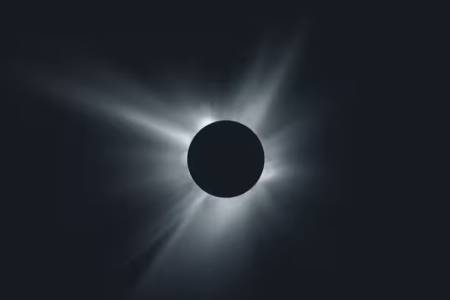 There are lots of maps showing where to go for the April 8th 2024 total solar eclipse and others showing the statistical chance of clouds such as https://www.washingtonpost.com/weather/2024/02/22/april-eclipse-clouds/ From Little Rock Arkansas to the Mazatlan coast there is a high probability of clear weather. The cities from Indianapolis through Cleveland OH, Rochester and Syracuse...
Seiko Designs Equatorial Sundial Watch
Sunday, 24 March 2024 01:42
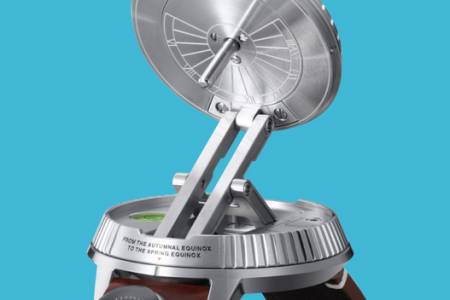 When is a watch not a watch? When it unfolds into an equatorial sundial. The watch, designed by Yu Ishihara is called a "Watch Exclusively for Sunny Men" and was part of a contest sponsored by Seiko to "help reimagine what a watch can be", aimed at creativity and perhaps for eventual production. Read about it at...
Rare Astrolabe Discovered by Chance in Verona Museum
Wednesday, 06 March 2024 00:17
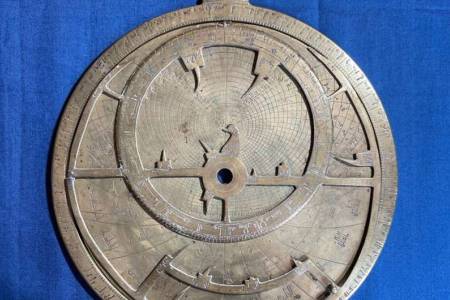 Dr. Federica Gigante, from Cambridge Univerity's History Faculty, discovered a rare astrolabe sequestered in a museum at Verona, Italy. Publishing in Nuncius (1 March 2024) Dr. Gigante presents "a hitherto unknown remarkable astrolabe from Al-Andalus which likely belonged to the collection of Ludovico Moscardo (1611–1681) assembled in Verona in the seventeenth century. The...
NASS 2024 Conference to be held in Vancouver, BC June 20-23
Friday, 23 February 2024 17:42
 The North American Sundial Society (NASS) will hold its 2024 conference in Vancouver, British Columbia, Canada from Thrursday June 20th to Sunday June 23rd. The conference will be held at the Fairmont Hotel Vancouver, 900 West Georgia Street, Vancouver BC. The conference will start Thursday afternoon with a traditional reception and sundial door prizes. Friday will be a...
World Sundial Day
Friday, 23 February 2024 16:53
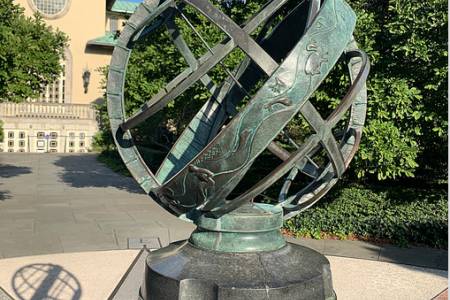 Spanish sundialist Esteban Martínez has launched the resolution to establish the World Sundial Day to occur each year on the Spring Equinox. According to the petition circulated by Martinez,
"Reason Sundials represent the union of disciplines as disparate as Astronomy, Mathematics, [and] Geography...They have an undoubted didactic value in teaching astronomy to young people and as...
Spanish sundialist Esteban Martínez has launched the resolution to establish the World Sundial Day to occur each year on the Spring Equinox. According to the petition circulated by Martinez,
"Reason Sundials represent the union of disciplines as disparate as Astronomy, Mathematics, [and] Geography...They have an undoubted didactic value in teaching astronomy to young people and as...
NASS Course "Elements of Dialing" Starts Jan 6, 2024
Saturday, 18 November 2023 18:21
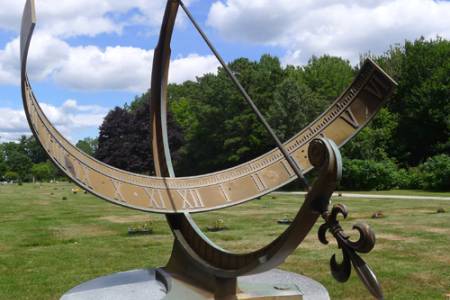 NASS is pleased to announce the upcoming third instance of Elements of Dialing, our introductory course about sundials, their history, and the science that makes them work. The free 13-lesson course, intended for those are new to sundialing, runs from January 2024. The course coordinator will be Steve Lelievre, our Secretary and editor of The Compendium. Steve will be assisted from time to time...
Smithsonian Photo Contest - Jaipur Sundial
Sunday, 05 November 2023 16:30
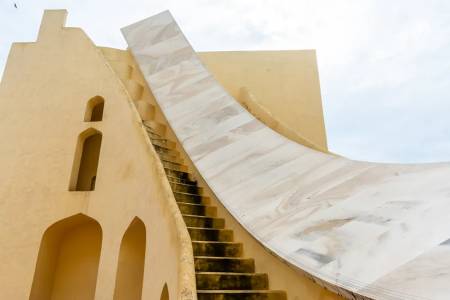 Smithsonian Magazine holds a photo-of-the-day contest. Winner on 30 Oct 2023 was Harita Sistu who took a photo of the large sundial of Jantar Mantar, Jaipur India (taken in July 2022). Harita notes: "I wanted to try my best to capture just how massive the instrument is and bring focus into the incredible skill that went into designing and constructing it."
See other NASS...
Smithsonian Magazine holds a photo-of-the-day contest. Winner on 30 Oct 2023 was Harita Sistu who took a photo of the large sundial of Jantar Mantar, Jaipur India (taken in July 2022). Harita notes: "I wanted to try my best to capture just how massive the instrument is and bring focus into the incredible skill that went into designing and constructing it."
See other NASS...
Houston Pavillion - World's Largest Sundial
Friday, 14 July 2023 23:08
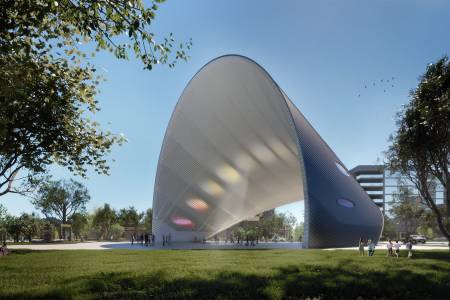 A sundial or performance center or solar generator? It's all three. Called the Arco del Tiempo (Arch of Time), the design by Berlin architect Riccardo Mariano provides the projection of the sun's rays onto the ground through tinted glass apertures spanning the length of its arching ceiling. The elliptical shaped spots change every hour, telling "the solar time each day and delight visitors with...
Sun Tower Update
Saturday, 01 July 2023 00:36
 According to NewAtlas.com (https://newatlas.com/architecture/sun-tower-open/), construction of the Sun Tower exhibition building and outdoor theater is underway in the Chinese city of Yantai. The tower is being constructed by a French firm, Ducks Sceno and the engineering firm Arup, raising to 50m (164 ft) gracefully into the sky. The tower symbolizes the historic watch towers of...
Point of Infinity Hyperbolic Monument in San Francisco
Sunday, 25 June 2023 22:17
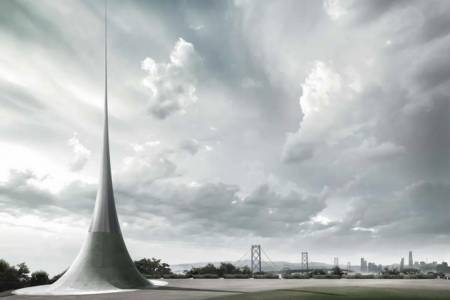 Julie Baumgardner in The Art Newspaper of Jan 13, 2023 reports on the construction project of Point of Infinity, a nearly 70 foot (21m) hyperbolic cone will reach toward the sky as part of a 50 million dollar park development on Treasure Island and Yerba Buena Island.
In a competition held by the San Francisco Arts Commision on behalf of the Treasure Island Development Authority, Hiroshi...
Julie Baumgardner in The Art Newspaper of Jan 13, 2023 reports on the construction project of Point of Infinity, a nearly 70 foot (21m) hyperbolic cone will reach toward the sky as part of a 50 million dollar park development on Treasure Island and Yerba Buena Island.
In a competition held by the San Francisco Arts Commision on behalf of the Treasure Island Development Authority, Hiroshi...
Ice Sculpture Ephemeral in Time
Thursday, 30 March 2023 00:03
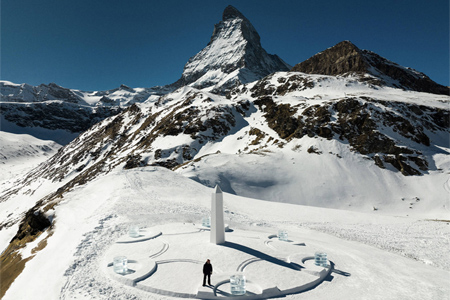 In the Swiss mountains near the resort of Zermatt just beneath the Matternhorn, Stir World reports that "famed luxury Swiss watchmaker Hublot announced Daniel Arsham as its new ambassador, with a compelling piece of temporary land art. Aptly titled "Light & Time", the work is a Hublot-inspired 20-metre sundial resting in the shadows of the Matterhorn mountain."
This sculptural is billed as...
In the Swiss mountains near the resort of Zermatt just beneath the Matternhorn, Stir World reports that "famed luxury Swiss watchmaker Hublot announced Daniel Arsham as its new ambassador, with a compelling piece of temporary land art. Aptly titled "Light & Time", the work is a Hublot-inspired 20-metre sundial resting in the shadows of the Matterhorn mountain."
This sculptural is billed as...
New Sundial for Kika Silva Pla Planetarium
Sunday, 18 December 2022 23:00
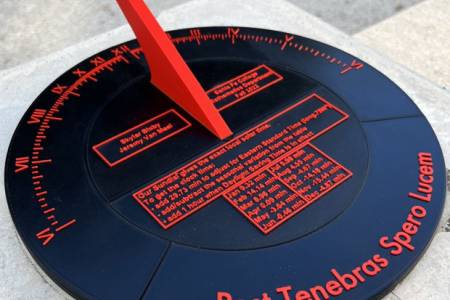 Sklar Bixby and Jeremy Meel, students at Santa Fe College in Florida took on a project to design and 3D-print a new sundial for the Kika Silva Pla Planetarium in Gainesville Florida (located on Santa Fe's Northwest Campus). Under the guidance of Dr. Philip Pinon, Sklar and Jeremy took on a semester long project as part of the Exploring Honors Mathematics class. They designed a horizontal sundial...
Sundials in Grammar School
- Details
- Hits: 7977
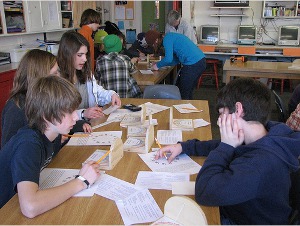 Avid dialist and former The Grammar School teacher and head of the Putney, VT school, Mac Oglesby guides 6th graders to plan and construct their own working sundials. Oglesby's students learned how to correctly position their dials to display the accurate time throughout the year.
 NASS-SpiderSundial.pdf NASS-SpiderSundial.pdf | [ ] | 5611 kB |
Brief History of Sundials and How to Make & Use Them
- Details
- Hits: 4919
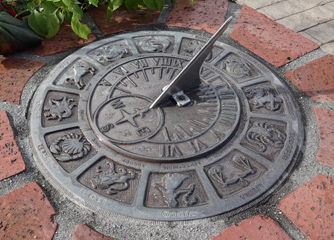 Dr. Jessica Warren, lecturer of physics and astronomy at Indiana University Northwest, is active in science outreach and education. She is also passionate about sundials. For Indiana University outreach shecreated a video "The Garden Sundial - Much More than an Ornament" that presents a brief history of the sundial, how they work, and where to get one or make one.
You can watch the video on YouTube at https://www.youtube.com/watch?v=K10nPV69Q1A. It is also part of the North American Sundial Society library of videos, found on this website at https://sundials.org/videos/making-and-using-sundials.html where NASS has a collection of videos on sundials, timekeeping, and interviews with sundialists on how they make sundials.
At the end of her presentation, Dr. Warren provides a list of reference material about sundials. Her entire video including references is available as a PDF and is available for download at the bottom of this article. Additional references and sundial topics are available on the NASS sundial links page: https://sundials.org/dial-links/general-sundial-links.html. Read more about the fascinating world of sundials.
| The Garden Sundial - Much More than an Ornament - J.Warren.pdf | [ ] | 5542 kB |
Solargraphy - Takes a while - But it's worth it
- Details
- Hits: 10472
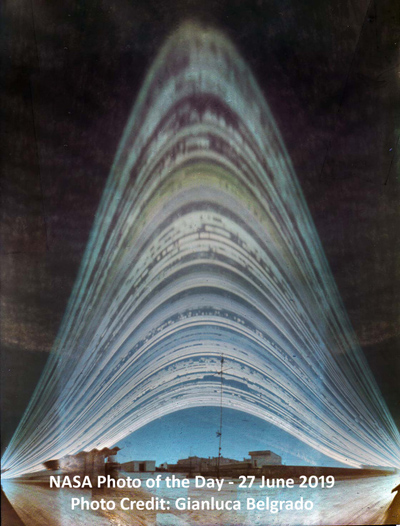 In the NASA Photograph of the Day for 27 June 2019 is a beautiful photograph by Gianluca Belgrado using a pinhole camera. https://apod.nasa.gov/apod/ap190627.html As explained by NASA, "This persistent six month long exposure compresses the time from solstice to solstice (December 21, 2018 to June 16, 2019) into a single point of view....Fixed to a single spot at Casarano, Italy for the entire exposure, the simple [pinhole] camera continuously records the Sun's daily path as a glowing trail burned into the photosensitive paper. Breaks and gaps in the trails are caused by cloud cover. At the end of the exposure, the paper was scanned to create the digital image...."
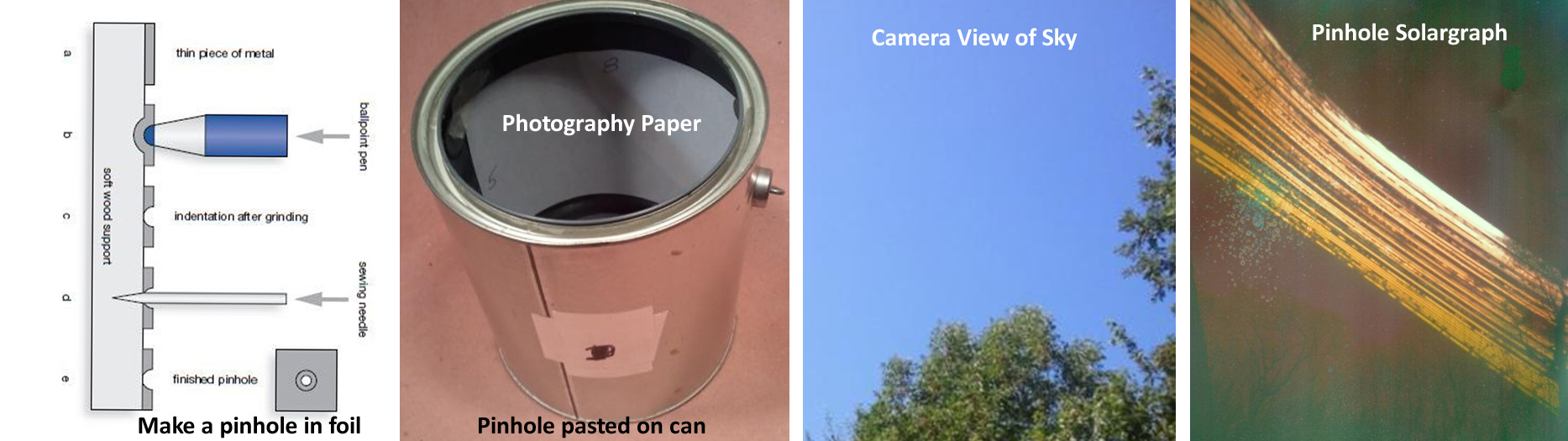
In 2011 Art Paque explained the art of solargraphy to members of the North American Sundial Society at their annual conference in Seattle. The construction steps involve creating a pinhole in thin foil, then taping the foil onto a tin can that has photographic paper inside and opposite the pinhole. The lid on the can is sealed and most important, pointed at the sky with firm support to prevent moving. The rest is up to nature as the sun crosses the sky each day. Beautiful solargaphs such as from Gianluca can be obtained with patience tracking the sun for three to six months. In the end your solargarph will be a day by day time capsule of solar observation.
Type "solagraphy" into your web search engine and you will discover a host of sites showing the details of making your pinhole camera. For example: http://www2.uiah.fi/%7ettrygg/camera.html and http://www.pinholephotography.org/Solargraph%20instructions%202.htm
Waterloo 3D Sundial Arches
- Details
- Hits: 7818
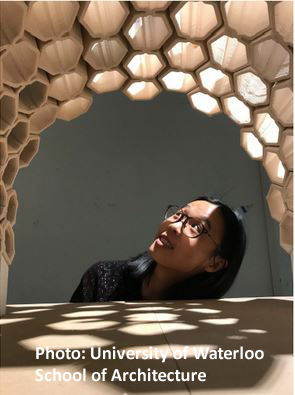 Students at the University of Waterloo School of Architecture in Cambridge, Ontario are experimenting with the benefits of 3D design and printing. In particular Joanne Yau created a set of hexagonal hollow bricks called sundial arches that lets in sunlight from different portions of the arch as the sun travels across the sky. We expect that the length to width ratio of the bricks can tailor sunlight for specific times of the year (summer, spring/fall, or winter).
Joanne Yau was one of three teams challenged to learn how to operate a new industrial 3D printer capable of squirting out clay. Professor Correa, interviewed by 3Dprint.com said “There is no other way to make these kinds of façades without enormous cost and time,” said Correa, who has been involved in 3D printed research on an even more advanced level, studying how such objects respond when exposed to varying degrees of moisture and temperature. “They are completely unique.” “The printer allows us to make much more complex geometry,” said Joanne Yau, part of the team that 3D printed bricks for the ambitious arch/sundial. “To make this by hand or to extrude it would be virtually impossible.”
See a video of how the 3D clay bricks are created in an article by Bridget O'Neal June 5, 2019: https://3dprint.com/245698/whistling-walls-sundial-arches-ontario-architecture-students-3d-print-clay/
Teachers & Architects Draw Sundials
- Details
- Hits: 7099
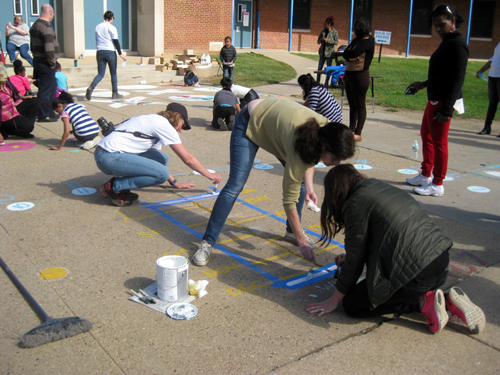 Grimm & Parker Architects sponsored a "Green Apple Day" on October 15, 2016 to help two Baltimore City Schools - Graceland Park ES/MS and Holabird Academy ES/MS - receive analemmatic sundials on their front sidewalks. The weather was perfect as teachers and volunteers from G&P chalked out and then painted simple 16 x 5 foot analemmatic sundials.
The sidwalks were aligned true North-South, making dial lay-out easy. With tape measures in hand, they marked out the focal points and north point of the analemmatic ellipse. Then, using the time-honored principle of constant distance they used a chalk line between those 3 points to maneuver a piece of chalk following the shape of an ellipse. For the sundial, the ellipse stretched from 5am to 7pm. The hour marks were made using two tape measure to check positions that were quickly followed by drawing of the hour circles with a plastic lid. While volunteers painted the hour circles others chalked out the walkway whose monthly lines and solstices were quickly painted as well. The final touch was the inclusion of the East and West Bailey points that determine the direction of the rising and setting sun. With a lot of support and good organization, both dials were finished in 3 hours!
Museo Galileo
- Details
- Hits: 3237
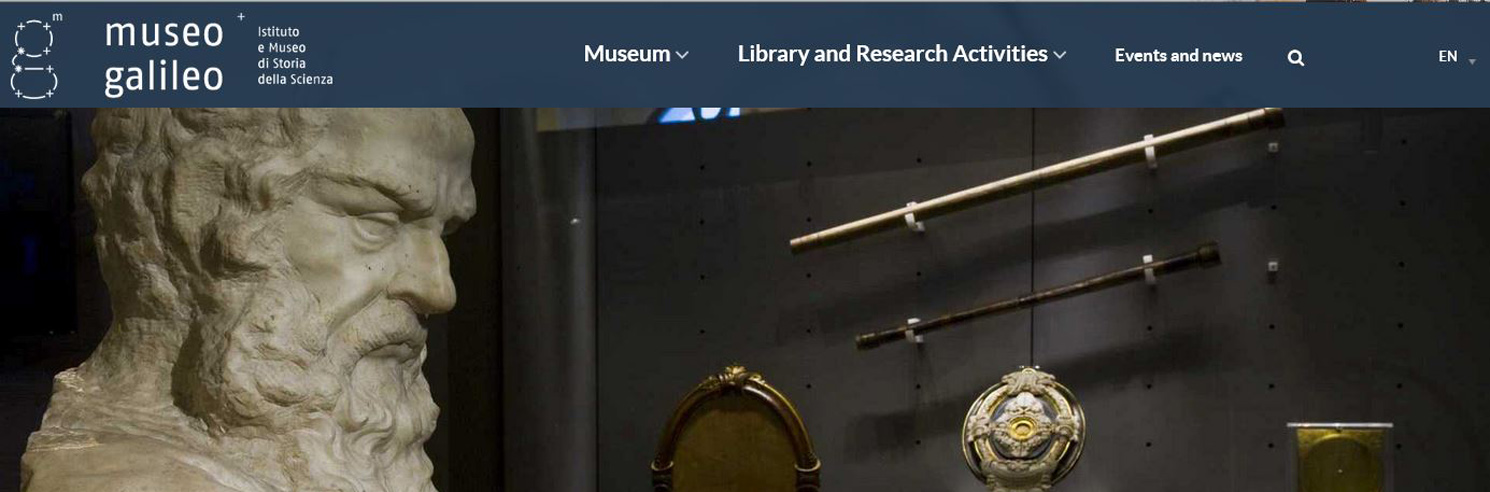
Want to travel? Want to see sundials? Well, you can do both by taking a virtual tour of the Galileo Museum (Museo Galileo) in Florence, Italy. Beside showing you detailed sundials, astrolabes, and quadrants in their collection, they host a series of short 2 minute videos on sundials and many other topics.
This is a fun virtual site to explore: https://catalogue.museogalileo.it/ Here you can read about the biography of Galileo or many other famous scientists or you may want to browse many of 1000 astronomical instruments in their collection, or watch a video on Galileo's astronomy or see how the the heavens can be seen in the armillary sphere sundial, or consider the history of the lightning rod with a demostration of gunpowder blowing apart a small wooden house (called a "Thunder House") that doesn't have one.
There are many short videos about sundials and astrolabes. And of course there is the Monumental Sundial at the entrance to Museo Galileo. Click here to watch a short animation of how this gnomonic sundial works. The Museum has many of these instructional videos. Be sure to visit their video catalogue: https://catalogue.museogalileo.it/index/VideoIndexByThematicArea.html
Sunlight and the 1918 Spanish Flu
- Details
- Hits: 8037
.jpeg) 1918 Photo of Camp Brooks Open-Air Hospital Boston - Nat'l Archives 1918 Photo of Camp Brooks Open-Air Hospital Boston - Nat'l Archives |
We feel the menance of the Corona Virus (Covid-19) and the imposed social isolation. Although worse than the typical annual flu, the Corona Virus pales to the worldwide pandemic of the Spanish Flu (isolated as the H1N1 virus). What does this have to do with sunlight? I am indebted to Richard Hobday's well researched article:
Here is his paragraph on "Sunlight and Influenza Infection"
"Putting infected patients out in the sun may have helped because it inactivates the influenza virus.[7] It also kills bacteria that cause lung and other infections in hospitals.[8] During the First World War, military surgeons routinely used sunlight to heal infected wounds.[9] They knew it was a disinfectant. What they didn’t know is that one advantage of placing patients outside in the sun is they can synthesise vitamin D in their skin if sunlight is strong enough. This was not discovered until the 1920s. Low vitamin D levels are now linked to respiratory infections and may increase susceptibility to influenza.[10] Also, our body’s biological rhythms appear to influence how we resist infections.[11] New research suggests they can alter our inflammatory response to the flu virus.[12] As with vitamin D, at the time of the 1918 pandemic, the important part played by sunlight in synchronizing these rhythms was not known."
Stitch in Time
- Details
- Hits: 10358
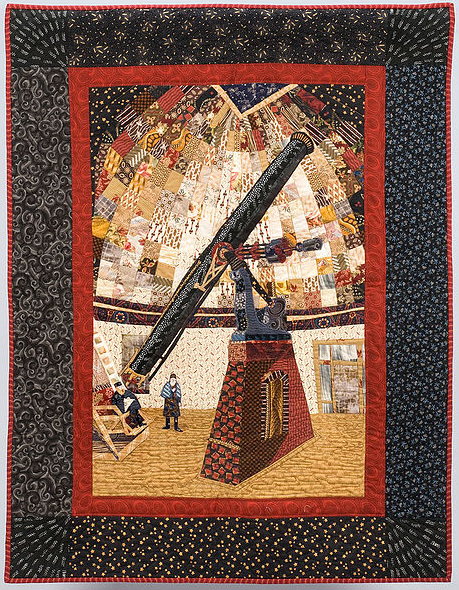 Sundials are often created at the instersection of science and art. Quilting has made its mark as well. For example in Burnsville North Carolina is the Quilt Block Sundial, painted in bright quilt blocks on a 8x8 foot board above the entrance to the Yancy Common Times Journal Building.
Now comes Altazimuth Arts, an enterprise established by Sara Schechner, well-know historian of science who is curator of Harvard's Collection of Historic Scientific Instruments. But Schechner is also active in the Studio Art Quilt Associates, Quilters' Connection of Watertown MA, and member of Quinobeguin Quilters guild. As she explains, "Recent quilts are inspired by history and the night sky, the built environment wet within nature, and by the many-faceted meanings of tangible things."
Illustrated is the US Naval Observatory 26-inch refractor made by Alvan Clark & Sons in 1873. "The inspiration for my quilt was an engraving from a newspaper story celebrating the work of the telescope. The print shows astronomer Simon Newcomb (at the eyepiece) and Superintendent Rear Admiral Benjamin F. Sands (standing) in the dome with the brand new telescope in late fall 1873. The engraving was based on a photograph of the same scene." Visit Schechner site at www.altazimutharts.com
Sundial as Functional Art
- Details
- Hits: 7412
 This weekend on October 6th a new sundial was dedicated in Atlanta, Georgia. Ayokunle Odeleye, nationally renowned artist, has created a modernistic bronze and stainless steel sundial called “Chi Wara Sundial Lantern.” The 8-foot tall sundial is accessible at ground level, sitting in a 20-foot circular plaza with hour marks at the circumference.
Interestingly, it functions as a sundial by day, but shines as a lantern by night. The public artwork honors twelve community leaders from Cascade Heights located in southwest Atlanta for their spiritual and cultural contributions to their community and Atlanta.
Odeleye’s sundial took inspiration from Mali folklore of West Africa and the headdress of Chi Wara, a mythical creature that is half-man and half-antelope. As noted by the city of Atlanta, the sundial represents “a headdress in special ceremonial harvest dance designed to pass on knowledge from the elders to young people in the viliage. Odeleye’s ‘Chi Wara Sundial Lantern’ interprets this mythological image and conceptually uses it to suggest the ceremonial passing of scholarship from Cascade elders to the youth of this community."
Reference: Saporta Report - David Pendered - Oct 3, 2012
Site Search
Sundial Question?
Current Sun
Sundial = Mean Sun + EoT
Select Sundials by State/Province
Who's Online
We have 822 guests and no members online