



What's New Under The Sun

Thursday, 22 January 2026 18:30

Get ready to travel. This year the 31th NASS annual conference will be held in Louisville, KY at the Hyatt Regency Hotel June 25th - June 28th. The conference starts Thursday June 25th at 4:30pm with an opening reception, introductions, and as always, the popular door prizes. Friday we will tour the local sundials via motor coach, including the Kentucky Vietnam Veterans Memorial in nearby...

Monday, 13 October 2025 22:49

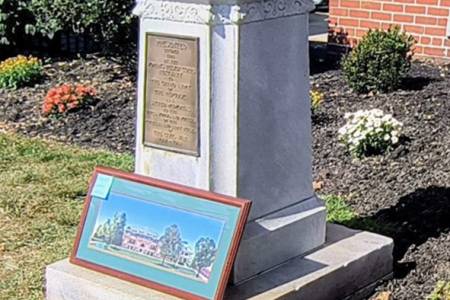
On October 4, 2025 Madison Historical Society of Ohio was able to have their sundial returned after 32 years, when in 1993 it was moved to the lawn of Lake County Courthouse to reduce the chance of vandalism. The sundial was originally placed at Madison Home 100 years ago on Saturday, October 24, 1925 during a conference of the Women's Relief Society.  From 1904 to 1962 the state ran this...

Monday, 15 September 2025 19:42

NASS is pleased to announce the upcoming fifth instance of Elements of Dialing, our introductory course about sundials, their history, and the science that makes them work. The free 12-lesson course, intended for those are new to sundialing, runs from 27 October 2025 until 26 April 2026. The course instructor is Robert Kellogg, NASS Vice President and Sundial Registrar.  Bob will be...

Thursday, 11 September 2025 23:11

A Hungarian born American scientist, Mária Telkes (1900-1995), was called "The Sun Queen" and among other honors, was postmousthly inducted into the National Inventors Hall of Fame. She lived to 95 and for most of her life developed solar power in a variety of forms. Trained as a biophysicist, she worked for Westinghouse Electrical and Manufacturing Company in Pittsburgh, PA, where she...

Thursday, 28 August 2025 23:25

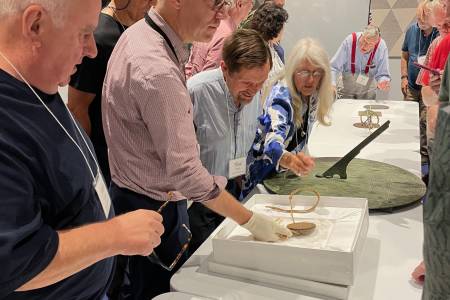
The annual NASS Conference was held 7-10 August, 2025 in Ottawa.  As usual, the conference began late Thursday afternoon with an introduction social and a "grab bag give away", taking your chances with tickets to win the bag's prize.  Will Grant was the final winner of the Walton Double Planar Polar Sundial, but Paul Ulbrich beat the statistic odds and won this prize three times,...

Tuesday, 10 June 2025 18:51

  Prosciutto di Portici (Ham) Sundial Photo: Getty Images The Prosciutto di Portici Sundial, more often called the Portici Ham Sundial, dates from the first century somewhere between  8 BCE to 79 CE.  This small silvered bronze dial was uncovered on 11 June, 1755 in the ruins of Herculaneum (current day Portici) in the "Villa of the Papyri", buried in...

Friday, 06 June 2025 21:01

  Sundial dedication May 31, 2025.  At left is Kathleen Stuckey Fox, with the City Proclamation presented by Mayor Pat Moeller and City Council on-lookers Carla Fiehrer and Susan Vaughn offering congratulations. On May 31, 2025 at 1pm, the Hamilton, Ohio, sundial (NASS Sundial Registry #1109) was re-dedicated in Monument Park. Originally dedicated in 1941 to the...

Monday, 24 March 2025 21:33

Several years ago Frans decided to write the course on sundials that included self assessment questions to force students not only to read the text, but to internalize the concepts. And a final submittal question "not necessarily a difficult question, but: no answer, no new lesson." Thus Frans Maes began writing lessons and sending them out to students. NASS has now used his material to create...

Monday, 24 March 2025 15:37

In a 24 March 2025 article from the on-line Science Advisor (American Association for the Advancement of Science) Phie Jacobs summarizes the "great debate" of the yearly shift from standard time to daylight savings time.  In January 2025 the US Senate introduced the Sunshine Protection Act to permanently have daylight savings time year round. Certainly 54% of Americans do not like the...

Friday, 21 March 2025 19:26

Perhaps the most famous alignment circle in the United States is the Cahokia Woodhenge near St. Louis constructed between 700-1400 CE by Cahokia Indigenous native Americans. But there were an estimated 10,000 other earthen mounds that once were scatter across the mid-west.. In an article from Atlas Obscura (https://www.atlasobscura.com/articles/octagon-earthworks-ohio) by Olivia Young on March...

Friday, 21 March 2025 18:37

The Hamilton dial is in the restorative care of Jarrett and Celene Hawkins (Hawkins & Hawkins Custom, LLC in Cincinnati Ohio https://www.studio-hawkins.com/) in preparation for the dial's dedication on Saturday, May 31, 2025. The face of the Hamilton Grand Army of the Republic (GAR) sundial has been cleaned and bead-blasted showing the dial as it was cast 84 years ago. In the process,...

Tuesday, 17 December 2024 23:47

In November 2024, a team consisting of members from SPL, TTDG and CMD of VSSC successfully designed and installed an accurate and fully functional sundial at the Rocket Garden of VSSC Space Museum, Thumba (8.53°N, 76.86°E). Following a space theme, the vertical gnomon is a 3-stage rocket that casts its daily and seasonal shadow on a dial face 1 1/2 meters by 1 meter.  The the sundial face...

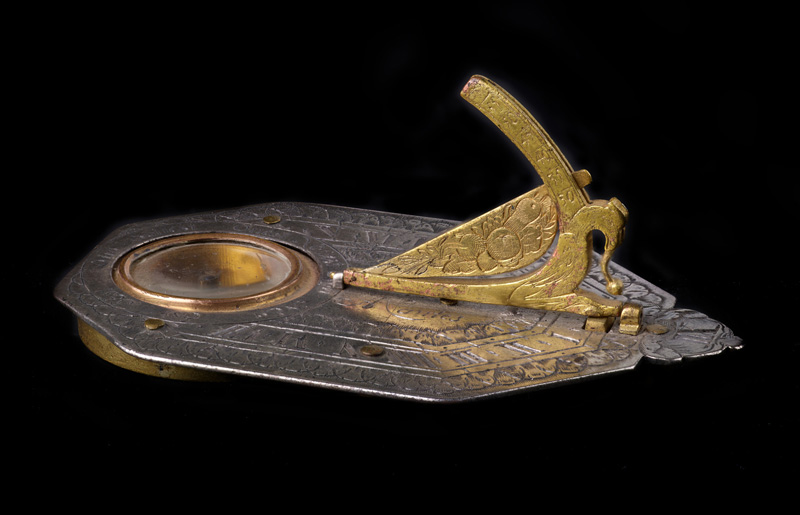
nass news 2022 aug indiana sundial MA.32556 Smithsonian Collection - Pocket sundial by Bourgaud of Nantes, 1660–1675. (MA.325565)

From the National Museum of American History is an article about "How did a French pocket sundial end up buried in a field in Indiana?" published 20 July 2022 by Kidwell & Schechner.  

It started in 1860 when Dr. Elisha Cannon, while plowing a field in Indiana, came across a strange object. It was a French Butterfield sundial. It ended up in the Smithsonian collection 100 years later, where it quietly sat until recently when curator Peggy Kidwell wanted to learn more. She contacted Dr. Sara Schechner, David P. Wheatland Curator of the Collection of Historical Scientific Instruments at Harvard University, to join the investigation.

The dial is inscribed "Bourgaud Nantes" showing it was from the workshop of a clockmaker in Nantes, France. As with all Butterfield dials it contained a magnetic compass with declination corrections for orienting the dial to north and a miniature plumb bob to hold the dial level. The gnomon support is in the traditional shape of a bird allowing the gnomon itself to be adjusted to a range of latitudes. Look closely at the chapter ring of hour marks in Roman numerals.  Outside the numerals is one hour line scale and on the inside of the numerals is a second scale.  The user could approximate the time between these two scales, done for the extreme latitudes 30 and 55 degrees.

"In her research on sundials in the American colonies, Schechner has drawn attention to several of these dials, and notes that some 18th-century French sundial makers, like Pierre le Maire (and his son of the same name), made pocket dials that carefully listed the latitude of places of French interest in both North and South America." How did the dial end up in Indiana? It could have been carried there by Dr. Cannon and his wife Gulielma, Quakers who in 1840 left North Carolina, finding that "living in a state where African Americans were legally enslaved was intorable." Or the dial may have been left a century earlier when the French occupied much of what is now Indiana, leaving outposts such as Terre Haute and possibly a lost sundial.

Read the article: https://americanhistory.si.edu/blog/pocket-sundial