
Portland Librarian Searches for Rare Sundial
UPDATE...Portland's long lost CREHORE SUNDIAL could be anywhere... Watch WCSH CHANNEL 6 NEWS to learn about the search:
http://www.wcsh6.com/mb/home/portland-maine-s-long-lost-sundial-could-be-anywhere/59670712
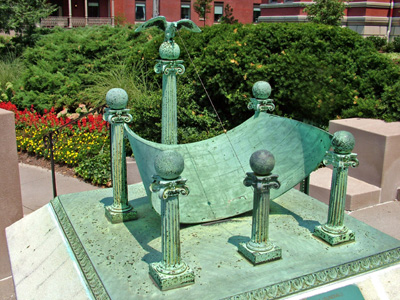 In The Forecaster, the digital paper of Portland, Maine, Collin Ellis describes the mystery around a missing sundial made more than a century ago. Albert Crehore from Yonkers, NY developed an entire theory of sundials ... all on his own, relates Fred Sawyer, president of NASS, and he received US Patent 794,787 in 1905 for the design. Three known dials are in the NASS website Registry: #327 Johns Hopkins Hospital, Baltimore, Maryland; #445 Bucknell University, Lewisburg, Pennsylvania; and #681 Ohio State University, Columbus, Ohio. A fourth dial, now owned by Derek Boston (of the UK) was originally made for Sir William Preece and his estate in Carnarvon, Wales. According to records, at least two other dials were installed in Yonkers, New York,Northwest University in Evanston, Illinois and in Portland, Maine.
It is this last one that Samantha Duckworth is trying to find somewhere in the greater Portland area in time for the North American Sundial Society conference to be held there June 23-26, 2016. Collin Ellis in The Forecaster writes, "Duckworth, who began the search last August, said she started by speaking with garden societies in the area. Then they began searching the library's collection and historical records for any mention of the dial. Then she moved to the Main Historical Society. Then to real estate agents who may have seen it in a private home. Then to antique appraisers.... But so far, no luck." "Talking to people and trying to ferret out these things, that maybe the owner of a home looks at every morning is really cool work," Duckworth said.
Has anyone seen this dial? Read more at: http://www.theforecaster.net/portland-librarian-hopes-to-shine-light-on-rare-sundials-whereabouts/
- Details
- Hits: 11334
Cranford Dial Needed Help - Now it is Gone
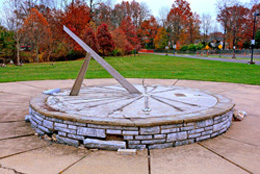 The North American Sundial Society likes to record public sundials that are in good or excellent condition. NASS Dial #797 in Cranford, New Jersey is a sad exception. In 1972 the Kiwanis Club of Cranford presented a 15-foot (5m) diameter sundial to Union College as an expression of interest in the college and the youth of Cranford. But the years have taken a toll where it sits adjacent to the William Miller Sperry Observatory. The dais stonework mortar has given way and the concrete dial face has deteriorated.
A plan to restore the dial was underway in late 2015. Dr. Stephen D. Nacco, of Union County College, Vice President, Administrative Services & Executive Assistant to the President set up a Sundial Fund under the Union County College Foundation, a 501(c )3 not-for-profit organization. Donations can be made online via the Web Site, http://www.uccfoundation.org/give.html with the donor selecting GIVE ONLINE NOW. Choose Donation Type "Other", and then put “Sundial” in the Additonal Comments Area as the reason for the donation.
Update:
Union County College considered a plan to restore or reconstruct the dial and there was a community fundraising effort. In 2019 UCC directed the demolition of the dial and stonework, leaving a gravel patch 15 feet in diameter. The Kiwanis plaque, the cardinal points, and the rest of the dial were, as Dr. Althos Brewer Vice President for Administrative Services at UCC wrote in an email (May 09, 2019), "I am responding on behalf of President McMenamin in regards to the contents of the Sun Dial. After further research into the matter, the contents from the demolition have been disposed."
- Details
- Hits: 11506
Cranmer Sundial Damaged and Restored

What happens to old sundials? In Denver, citizens of Cranmer Park are taking matters into their own hands. The City of Denver has generously committed $545,000 to the restoration of the Cranmer sundial and plaza through the Parks and Recreation and the Arts and Venues departments... but the citizens must raise another million dollars.
The history of Cranmer Park and why the current Erickson equatorial dial is there on the terrazzo plaza is fascinating history. The original Erickson dial was installed in 1941. Cranmer wrote in 1950 that "the sundial is only seventeen seconds of time East of the 105th Meridian on which Mountain Time is based, and since the whole setting is so accurate, one can set his watch by it." But in 1965 vandals blew the dial apart with dynamite. The community rallied, and by 1966 the Erickson company made and installed a copy of the original dial, Read the article in Downtown Main Street and visit the North American Sundial Registry Entry NASS #24.
But in 2014 the whole plaza began to sink and a complete overhaul required. The Erickson equatorial disk sundial shows signs of wear and damage.
Donations for the plaza and sundial restoration were made through Save Our Sundial Fund partner, The Park People [of Denver], a 501(c)3 organization.  Save Our Sundial has been instrumental in hosting fund raising events such as the June 8th 2014 benefit concert aptly named “Here Comes the Sundial”. For more information go to http://saveoursundial.com/.
Update:
The City of Denver generously committed $545,000 to the restoration of the Cranmer sundial and plaza through the Parks and Recreation and the Arts and Venues departments with the proviso that citizens raise another million dollars.
A group called "Save Our Sundial" began fundraising and an article of support appeared on this North American Sundial Society website. To date the article has over 3500 views. More important, as of June 2017 the “Save Our Sundial” project, raised $680,000. According to Andrew Kenny of the Denverite, "One major donor, the Harmes C. Fishback Foundation Trust, is led by a descendant of Mayor Benjamin Stapleton, whose administration built much of the park." The City Council has now increased its committment to $870,000.
The Denverite quotes Mark Tabor, assistant director for planning that "The city will have to put the contract before Denver City Council and hopes to start construction this year, with a likely 6 to 8 month construction process." And from Denise Sanderson, a local advocate and organizer for the park restoration, "So, what we’re doing is we’re reconstruction the whole thing – taking it down to the ground, building a foundation and building a drainage system," including repair of the chipped sundial and restoration of the inlaid terrazzo depiction of the Rocky Mountains landscape. See: https://www.denverite.com/looks-like-cranmer-park-sundial-will-saved-33833/
The Denver Patch reports that a total of $2 million is available for the project. Denise Sanderson, "a local advocate and organizer for the park restoration" created the "Save Our Sundial" project which is run by The Park People with Executive Director Kim Yuan-Farrel. City coordinator is Lauri Dannemiller, Executive Director of Parks & Recreation City & County of Denver. The restoration would not be possible without the financial support and community activism of the residence of Hilltop community. Neighbors met Monday, Dec. 18 to celebrate the beginning of the reconstruction at Cranmer Park which will begin in early 2018 and completed by late fall 2018 if seasonal weather permits.
See: https://patch.com/colorado/denver/sundial-repair-denvers-cranmer-park-begin
- Details
- Hits: 16075
Oatlands Sundial on Endangered List
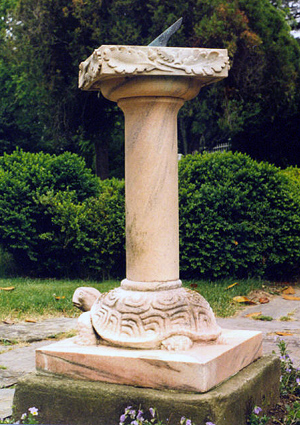 Sitting peacefully in the garden of the Oatlands Historic House and Garden near Leesburg VA, is a beautiful, but sadly in need of repair sundial. (NASS Registry #255) Each year the Virginia Association of Museums, comprising over 500 museums and historical sites within the state, receives nominations for conservation of Endangered Artifacts.
The Oatlands sundial is nominated to be considered for one of the Top 10 List of Endangered Artifacts for 2013. You can vote your concern for this sundial and donate to its restoration at: www.vamuseums-votefotoprendangeredartifact
Oatlands was an ante-bellum estate purchased as a “country home” by Edith and William Corcoran Eustis in 1903. Edith collected artifacts from all over the world, including the sundial. An early picture showed Edith standing in the garden with the sundial on its unmistakable pillar of pink marble balanced atop a large marble tortoise. See NASS sundial #255 (Virginia / Leesburg). Unfortunately the dial is misaligned and the top marble plinth has come loose from the pillar. The dial face and gnomon need restoration as well.
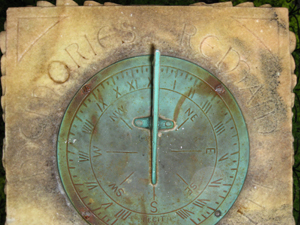 Lori Kimball, Director of Programming and Education, provided NASS with detailed photos of the sundial showing the marks “FECIT” (Made by) with a symbol of a crown and the date 1717. Analysis of the gnomon angle and dial face hour lines shows that the dial was designed for N 41 deg 54 min, the latitude of Rome. This is consistent with Edith Eustis antique collecting from Italy and France. But who made the sundial and is the date its true provenance?
Oatlands is raising funds to conduct a conservation assessment along with the sundial’s restoration. Kimball said she hoped the public would support Oatlands by voting to raise the visibility of the conservation work needed for the sundial. Voting is open until the end of August. The Virginia Association of Museums does not provide financial support - public donations such as yours are needed. The final Top 10 will be then selected by a panel of conservators and collections care professionals and announced mid-September.
Read: Leesburg Today Oatlands Sundial on Endangered Artifacts List
- Details
- Hits: 11840
Sundial Moved with Hidden Treasure
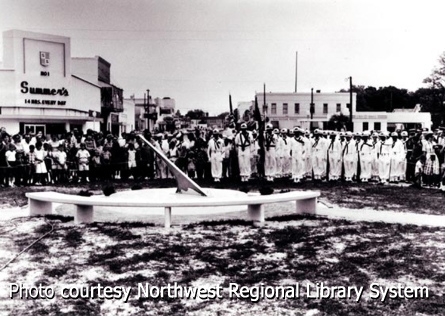
Many sundials do not survive the raveges of time. Buildings are destroyed and the sundial goes to oblivion. However, Panama City Commissioners had a different view of the sundial once located across from the Marina Civic Center.
William Whitson, Director of the Community Redevelopment Agency addressed the public during its recent meeting, as and recorded by Zack McDonald of the News Herald, "We always knew the sundial would be part of the redevelopment. But recently some of the info we've unearthed is pretty unusual."
Underneath the sundial, encased in concrete, was a section of a periscope captured from a German U-Boat. It was made into a 600-year time capsule, filled with nitrogen to protect its contents. The capsule, 6 inches in diameter and 18-inches long, was deposited beneath the sundial on Armed Forces Day May 18, 1963 to be opened 600 years hence in 2563.
The News Herald reported that "In 1963 the personnel of the Navy Mine Defense Laboratory gifted the sundial and the time capsule to the city. The sundial was chosen because of its timeless character in depicting the enduring relationship between the city and Navy."
The 9-foot diameter terrazzo sundial has a large "USN" on the North East quadrant edge of the concrete dais. On the off-white surface is a bronze tapered gnomon moved slightly to the south of center. Hour lines radiate from the gnomon foot and small arabic numerals grace the outer top edge of the dais. The sundial and its plaque of the Equation of Time is being moved to a new location near the Panama City "splash pad". The 600-year time capsule will presumably be once again located underneath the sundial.
Read More at the News Herald:
http://www.newsherald.com/news/government/city-won-t-open-600-year-time-capsule-1.157630
- Details
- Hits: 17511
World's Largest Sundial Cracks
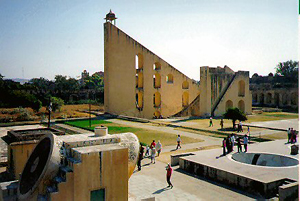 Sudhanshu Mishra reports in Mail-Online-India that the World Heritage Site at Jaipur, the Jantar Mantar astronomical observatory is in severe decline because of neglect.Maharaja Sawai Jai Singh, also known as Singh II, directed several the building of a astronomical observatories at Ujjain, Varanasi, Jaipur, Mathura, and Deli. From his research, Jai Singh II concluded that accuracy of observation could only be obtained with large, stationary instruments. The giant Jaipur observatory consisting of 16 different instruments took 15 years to build and was completed in 1734.
Most famous at Jaipur is the Brihat Samrat Yantra (translated as “large sun instrument”) a giant equatorial sundial with a polar gnomon height of 89 feet 9 inches. It’s thickness of 8 feet is wide enough for a stairway to the top. The overall dimension of this dial occupies a square 146 feet on a side to hold not only the gnomon but the equatorial band, called the Zodiac Circle (Rashivalaya), for reading the sun’s shadow to a phenomenal accuracy of 2 seconds of time. [1]
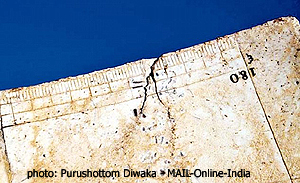 But the equatorial circle has worrying fractures and chemical treatments may have hastened structural disintegration. According reports in Mail-Online-India, “Superintendent of the Jantar Mantar, Om Prakash Sharma, said the matter of cracks and decay came to notice only recently and corrective measures would be taken soon.” “Jodharam Babar, deputy director in the state's archaeology and museums department, said the matter would be referred to experts before any corrective measures are taken.”
And to date, indeed, no action has been taken. India is letting the world’s largest sundial, a World Heritage Site, disintegrate before our eyes.
[1] Brandmaier, H. “Famous Sundials of India”, North American Sundial Society’s The Compendium, Vol. 2 Nr. 4 pp. 4-9, Dec. 1995
- Details
- Hits: 13308