
Analemma
- Details
- Hits: 5070
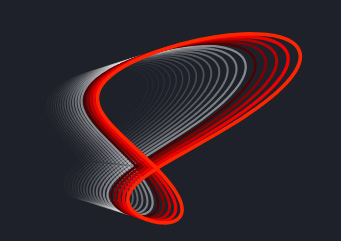 Russell Goyder has a new Python program simply called Analemma. But the program is far from simple as it is able to compute the shape and provide visualizations of the analemma for any planet in our solar system. His documentation and approach chooses to use the inertial frame of our solar system and apply vectors of position to determine the analemma and equation of time. "From the documentation, you can run and modify any [Python Jupyter] notebook yourself by clicking on the 'launch binder' button." Analemma uses SymPy and GAlgebra to encode and present the mathematics of the analemma.
His notebook is at: https://russellgoyder.ca/analemma/
A number of authors have used vector algebra to obtain trigonometric formulas many of us use. Goyder however uses the world of geometric algebra that consists of "outer products" and "bivectors". The terms are unfamiliar to many, but when explained, result in creating familiar trig formulas. An introduction to geometric algebra can be found at https://bivector.net/ with several informative videos.
Astronomy Teaching Tools - Sundials, Globes, Astrolabes and More
- Details
- Hits: 13228
John Krieger, a former science teacher, is a strong supporter of STEM in the classroom and science in the real world. Bollards at Laguna Nigel in southern California might offer the opportunity to teach a bit of astronomy.
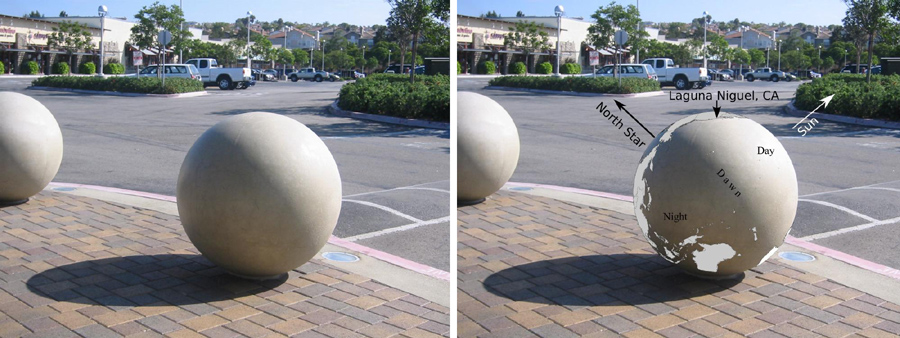
John says, "I don’t mean to imply that every concrete curb stop should be turned into an astronomical instrument. But why can’t we have more of these things around us? The ‘globe sundial’ is not an original idea of mine. People have actually made them, but they are depressingly rare....Sometimes someone does go to the trouble of making a beautiful, scientifically literate public display, and places it in full view of the everyday public, and even provides instructions..." 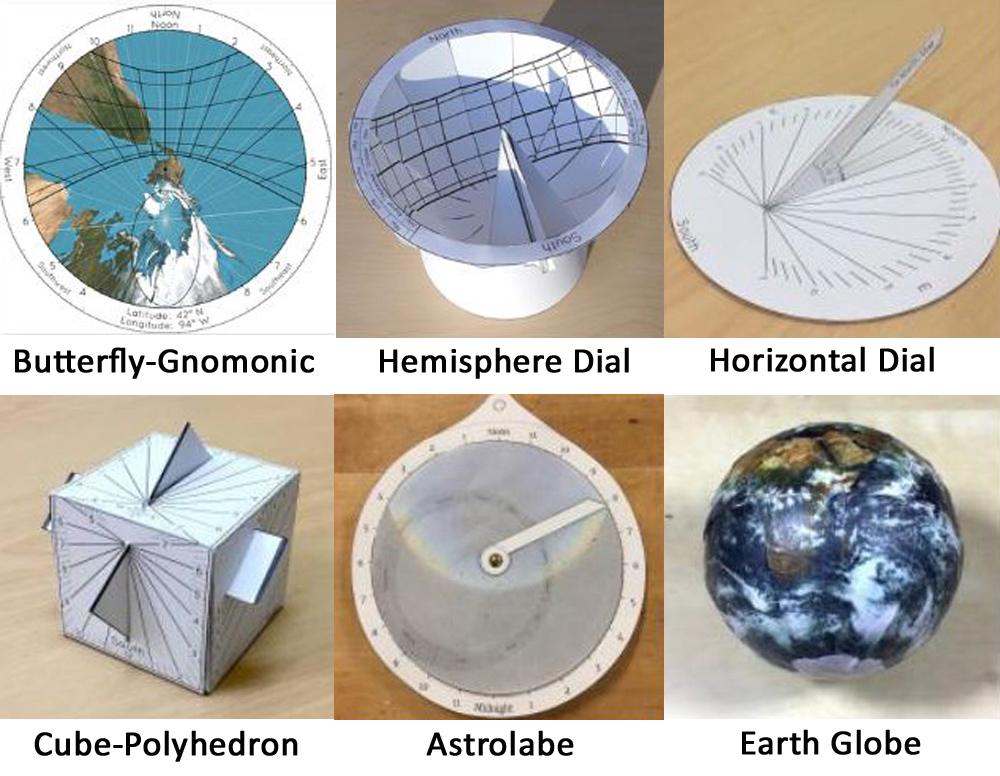 Many of these public displays are sundials and during John's career, he developed aids to teach astronomy to schoolchildren. At his website, he makes an array of paper sundials, globes, astrolabes and quadrants available in PDF form for printing and easy constructing to make an accurate sundial or globe with explanation of how it works. "Most of them are printable PDF files that you can download and give to kids to label, cut out, and use as the basis of some activity... Officially, I am making all of these works available under a Creative Commons — Attribution License, which means you may do anything you like with them, as long as you give me credit as the creator."
And don't worry about adjusting for latitude. His paper instruments are available for download at every 10 degrees of latitude from 60 deg south to 60 deg north, which for example would be appropriate for use in Reykjavik, Iceland. In North America, 20 degrees covers lower Florida, 30 degrees is suitable for southern California, 40 degrees works for the big US east coast cities, and 50 degrees is appropriate for Calgary in the heart of Alberta.
Downloads available at: https://www.astronomyforthinkers.com/downloads/
For the Hemispherical Dial, go to: https://www.instructables.com/A-Hemispherical-Paper-Sundial/
Sundial Atlas Paper Sundials
- Details
- Hits: 24881
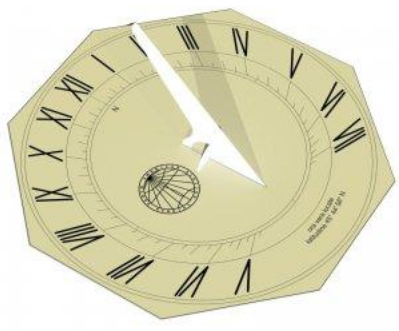 Need a small sundial for your display or science project? Want to show how different sundials cast shadows? Need a simple cut-out science exercise for your students? Fabio Savian of Milan Italy has the solution. For a number of years he has managed the Sundial Atlas website, ever increasing the number of sundial photos from around the world. Over the last several years he has worked very hard to create the gnomolab that includes a solar compass map of the earth, cloud software for creating analemmatic (human shadow) sundials, and a section for making paper sundials to your specification. The analemmatic dial measurements and papger dial designs are created as download PDF files. Four of those dials were created by the North American Sundial Society. Enjoy. Sundial Atlas Paper Sundials
Connetquot Students Use Sundials to Tell Time
- Details
- Hits: 16239
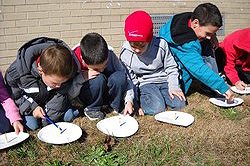 Second-grade students at Connetquot Elementary School in Islip, New York, created sundials using paper plates and pencils. The pencil gnomons were set mostly vertical by the students and then they traced the resulting shadows at three times during the day. This helped teachers Leslie Davis and Melissa Love demonstrate the sun’s apparent movement in the sky and talk about the earth's rotation as the cause. "The students really had fun," said Love, "and they were able to recognize that a sundial is a tool that can be used to measure time."
Sundials in Grammar School
- Details
- Hits: 14626
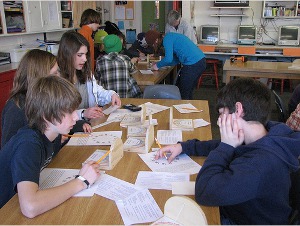 Avid dialist and former The Grammar School teacher and head of the Putney, VT school, Mac Oglesby guides 6th graders to plan and construct their own working sundials. Oglesby's students learned how to correctly position their dials to display the accurate time throughout the year.
 NASS-SpiderSundial.pdf NASS-SpiderSundial.pdf | [ ] | 5611 kB |
Brief History of Sundials and How to Make & Use Them
- Details
- Hits: 13494
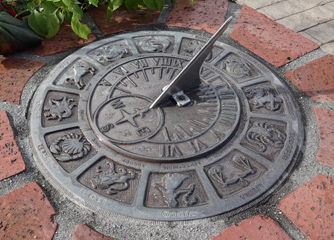 Dr. Jessica Warren, lecturer of physics and astronomy at Indiana University Northwest, is active in science outreach and education. She is also passionate about sundials. For Indiana University outreach shecreated a video "The Garden Sundial - Much More than an Ornament" that presents a brief history of the sundial, how they work, and where to get one or make one.
You can watch the video on YouTube at https://www.youtube.com/watch?v=K10nPV69Q1A. It is also part of the North American Sundial Society library of videos, found on this website at https://sundials.org/videos/making-and-using-sundials.html where NASS has a collection of videos on sundials, timekeeping, and interviews with sundialists on how they make sundials.
At the end of her presentation, Dr. Warren provides a list of reference material about sundials. Her entire video including references is available as a PDF and is available for download at the bottom of this article. Additional references and sundial topics are available on the NASS sundial links page: https://sundials.org/dial-links/general-sundial-links.html. Read more about the fascinating world of sundials.
| The Garden Sundial - Much More than an Ornament - J.Warren.pdf | [ ] | 5542 kB |
Solargraphy - Takes a while - But it's worth it
- Details
- Hits: 20359
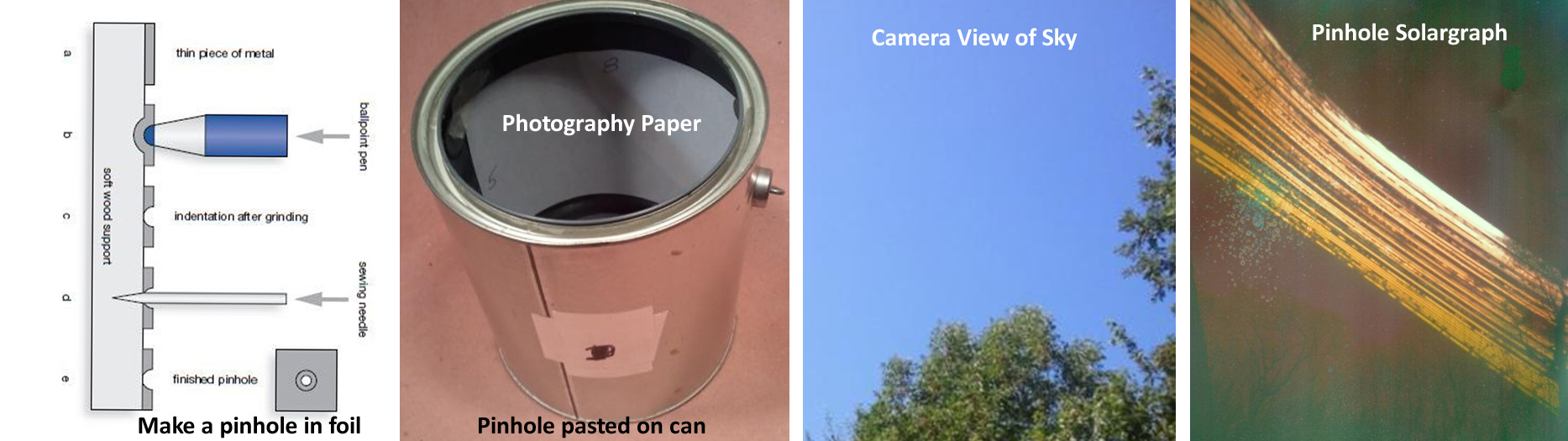
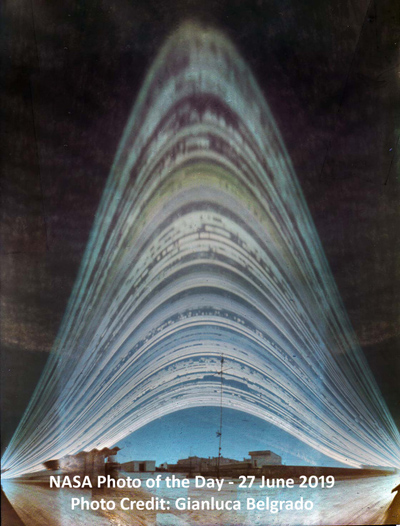 In the NASA Photograph of the Day for 27 June 2019 is a beautiful photograph by Gianluca Belgrado using a pinhole camera. https://apod.nasa.gov/apod/ap190627.html As explained by NASA, "This persistent six month long exposure compresses the time from solstice to solstice (December 21, 2018 to June 16, 2019) into a single point of view....Fixed to a single spot at Casarano, Italy for the entire exposure, the simple [pinhole] camera continuously records the Sun's daily path as a glowing trail burned into the photosensitive paper. Breaks and gaps in the trails are caused by cloud cover. At the end of the exposure, the paper was scanned to create the digital image...."
In 2011 Art Paque explained the art of solargraphy to members of the North American Sundial Society at their annual conference in Seattle. The construction steps involve creating a pinhole in thin foil, then taping the foil onto a tin can that has photographic paper inside and opposite the pinhole. The lid on the can is sealed and most important, pointed at the sky with firm support to prevent moving. The rest is up to nature as the sun crosses the sky each day. Beautiful solargaphs such as from Gianluca can be obtained with patience tracking the sun for three to six months. In the end your solargarph will be a day by day time capsule of solar observation.
Type "solagraphy" into your web search engine and you will discover a host of sites showing the details of making your pinhole camera. For example: http://www2.uiah.fi/%7ettrygg/camera.html and http://www.pinholephotography.org/Solargraph%20instructions%202.htm
Waterloo 3D Sundial Arches
- Details
- Hits: 14367
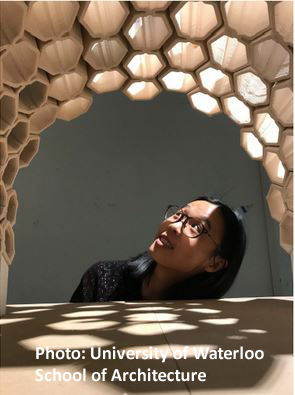 Students at the University of Waterloo School of Architecture in Cambridge, Ontario are experimenting with the benefits of 3D design and printing. In particular Joanne Yau created a set of hexagonal hollow bricks called sundial arches that lets in sunlight from different portions of the arch as the sun travels across the sky. We expect that the length to width ratio of the bricks can tailor sunlight for specific times of the year (summer, spring/fall, or winter).
Joanne Yau was one of three teams challenged to learn how to operate a new industrial 3D printer capable of squirting out clay. Professor Correa, interviewed by 3Dprint.com said “There is no other way to make these kinds of façades without enormous cost and time,” said Correa, who has been involved in 3D printed research on an even more advanced level, studying how such objects respond when exposed to varying degrees of moisture and temperature. “They are completely unique.” “The printer allows us to make much more complex geometry,” said Joanne Yau, part of the team that 3D printed bricks for the ambitious arch/sundial. “To make this by hand or to extrude it would be virtually impossible.”
See a video of how the 3D clay bricks are created in an article by Bridget O'Neal June 5, 2019: https://3dprint.com/245698/whistling-walls-sundial-arches-ontario-architecture-students-3d-print-clay/
Teachers & Architects Draw Sundials
- Details
- Hits: 13033
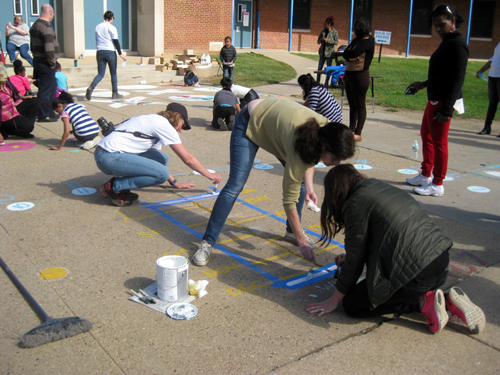 Grimm & Parker Architects sponsored a "Green Apple Day" on October 15, 2016 to help two Baltimore City Schools - Graceland Park ES/MS and Holabird Academy ES/MS - receive analemmatic sundials on their front sidewalks. The weather was perfect as teachers and volunteers from G&P chalked out and then painted simple 16 x 5 foot analemmatic sundials.
The sidwalks were aligned true North-South, making dial lay-out easy. With tape measures in hand, they marked out the focal points and north point of the analemmatic ellipse. Then, using the time-honored principle of constant distance they used a chalk line between those 3 points to maneuver a piece of chalk following the shape of an ellipse. For the sundial, the ellipse stretched from 5am to 7pm. The hour marks were made using two tape measure to check positions that were quickly followed by drawing of the hour circles with a plastic lid. While volunteers painted the hour circles others chalked out the walkway whose monthly lines and solstices were quickly painted as well. The final touch was the inclusion of the East and West Bailey points that determine the direction of the rising and setting sun. With a lot of support and good organization, both dials were finished in 3 hours!