

Teachers & Architects Draw Sundials
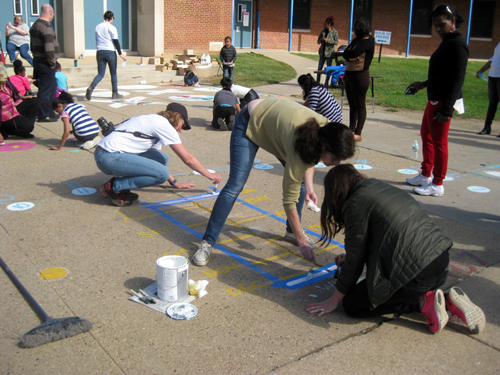 Grimm & Parker Architects sponsored a "Green Apple Day" on October 15, 2016 to help two Baltimore City Schools - Graceland Park ES/MS and Holabird Academy ES/MS - receive analemmatic sundials on their front sidewalks. The weather was perfect as teachers and volunteers from G&P chalked out and then painted simple 16 x 5 ft (5 x 1.5m) analemmatic sundials.
The sidwalks were aligned true North-South, making dial lay-out easy. With tape measures in hand, they marked out the focal points and north point of the analemmatic ellipse. Then, using the time-honored principle of constant distance they used a chalk line between those 3 points to maneuver a piece of chalk following the shape of an ellipse. For the sundial, the ellipse stretched from 5am to 7pm. The hour marks were made using two tape measure to check positions that were quickly followed by drawing of the hour circles with a plastic lid. While volunteers painted the hour circles others chalked out the walkway whose monthly lines and solstices were quickly painted as well. The final touch was the inclusion of the East and West Bailey points that determine the direction of the rising and setting sun. With a lot of support and good organization, both dials were finished in 3 hours!
- Details
- Hits: 11534
Graphical Methods for Making a Sundial
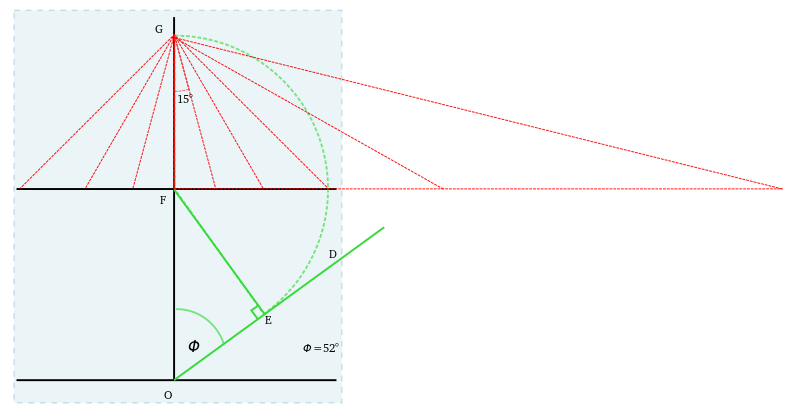 You can layout a sundial using only a compass and straight edge (and yes, a ruler and book of tangents so that you can set out the gnomon lines for your latitude). Clem Rutter has created a graphical set of instructions to make horizontal sundials taken from the challenge of Fred Sawyer of the North American Sundial Society to find how many different ways can you graphically lay out the lines of a sundial.
Here's where the fun begins. Clem Rutter in short order presents eleven historical approaches to drawing a sundial. Do you want to follow the method of Dürer (1525), Benendetti (1574), Clavius (1586) or the more modern methods of Leybourn (1660) or Ozanam (1673)? All these methods are graphical shown with instructions.
Join the centuries of gnomonists and begin your own Art of Dialing at https://en.wikipedia.org/wiki/Schema_for_horizontal_dials
- Details
- Hits: 15638
Anatomy of an Armillary Sphere Sundial
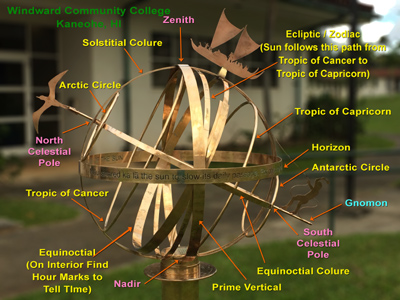
An armillary sundial also called an armillary sphere is a representation of both the terrestrial globe and celestial sphere. Often highly decorated, these are beautiful sundials.
An armillary sphere consists of a set of interlocking metal rings that form a spherical framework around a fixed rod, called the gnomon, which represents the polar axis of the sky as seen from earth. A small model of the earth is sometimes attached to the rod’s center inside the sphere. To function as a sundial the armillary must be tilted to the site's latitude to ensure that the sundial polar axis is parallel to the real earth axis.
The metal rings, usually made of brass or bronze, are referred to as armilla, which is Latin for bracelet. Armilla were prestigious armbands awarded to Roman soldiers for distinguished gallantry.
Unlike a celestial globe, which has a solid surface upon which the stars are illustrated, the armillary sphere is an open skeletal frame that lacks any depictions of the stars and constellations, except perhaps for its zodiacal ring. It is interesting to note that the image of an armillary sphere is sewn on the Portuguese flag, while that of a celestial globe is represented on the flag of Brazil, once a colony of Portugal.
Armillary spheres existed in Greece and China as early as the 4th Century BC. Mechanical versions were later introduced with moveable horizon rings and other features such as a positionable sun. As one of the first planetarium devices, the mechanical armillary sphere was used both for astronomical observations and teaching purposes.
An armillary sphere is ideally suited as a sundial. With its hour face inscribed on the inner circular surface of the Equatorial ring—also known as the Equinoctial—the gnomon’s shadow sweeps uniformly along with time, allowing the hour markings to be equally spaced along the equinoctial ring.
An armillary sphere can be turned into an armillary sundial by setting its celestial polar axis equal to the latitude of the sundial’s location and directed at the North Celestial Pole. The sphere’s Horizon ring is fixed parallel to the terrestrial horizon. And finally the meridian ring called the Solstitial Colure, which passes through the celestial poles and the two solstices, is rotated to the vertical position so as to coincide with the local meridian of the sundial’s location.
Terminology of astronomical coordinate systems
The nomenclature of an armillary sphere is based on the terminology of the following astronomical coordinate systems (see table below).
|
Armillary
Sphere |
Celestial
Coordinate System |
Geographical
Coordinate System |
Horizon
Coordinate System |
|
gnomon
|
celestial polar axis
|
terrestrial polar axis
|
terrestrial polar axis
|
|
North Celestial Pole
|
North Celestial Pole
|
North Geographic Pole
|
North Celestial Pole
|
|
South Celestial Pole
|
South Celestial Pole
|
South Geographic Pole
|
South Celestial Pole
|
|
Equinoctial
|
Celestial Equator
|
Equator
|
|
|
Equinoctial Colure
|
Celestial Equator
|
Equator
|
|
|
Solstitial Colure
|
|
|
local meridian
(upper half) + antimeridian (lower half) |
|
Tropic of Cancer
|
Tropic of Cancer
|
Tropic of Cancer
|
|
|
Tropic of Capricorn
|
Tropic of Capricorn
|
Tropic of Capricorn
|
|
|
Arctic Circle
|
Arctic Circle
|
Arctic Circle
|
|
|
Antarctic Circle
|
Antarctic Circle
|
Antarctic Circle
|
|
|
Prime Vertical
|
|
|
|
|
Ecliptic (Zodiac)
|
Ecliptic (Zodiac)
|
|
|
|
Horizon
|
|
|
horizon
|
|
Zenith
|
|
|
zenith
|
|
Nadir
|
|
|
nadir
|
|
center of earth
|
center of earth
|
center of earth
|
observer
|
Colure is one of two principal meridians (great circles) on the celestial sphere—equinoctial colure and solstitial colure.
• Equinoctial colure: meridian or great circle that passes through the celestial poles and the two equinoxes (first point of Aries and first point of Libra).
• Solstitial colure: meridian or great circle that passes through the celestial poles and the two solstices (first point of Cancer and first point of Capricorn).
Meridional (Local Meridian): upper half of the great circle that spans from the north point on the horizon to the zenith back down to the south point on the horizon. On an armillary sphere, it forms the upper half of the Solstitial Colure.
Antimeridian: lower half of the great circle that spans from the north horizon to the nadir back up to the south horizon. On an armillary sphere, it forms the lower half of the Solstitial Colure.
Equinoctial: refers to the celestial equator. The term equinoctial refers to the fact that the vernal and autumnal equinoxes occur when the sun passes through this great circle. The celestial equator is a projector of the earth’s equator onto the celestial sphere. The hour markings of the armillary sundial are inscribed on the inner surface of this ring.
Horizon: in astronomy, the unobstructed horizon is the circumference of the plane tangent to the earth’s surface at the observer’s location that intersects the celestial sphere. The horizon’s altitude is 0o.
Zenith: in the horizon coordinate system, it is the position directly overhead on the celestial sphere. The zenith’s altitude is 90o.
Nadir: in the horizon coordinate system, it is directly downward, diametrical opposite the zenith. The nadir’s altitude is –90o. In the modern art of geodesics, since the earth is not a sphere, but a slightly oblate spheroid, the line of nadir does not intersect with the center of the earth.
Prime Vertical: the great circle that passes through the zenith and nadir, and intersects the horizon at its east and west points.
Ecliptic: apparent path of sun on the celestial sphere. The ecliptic is the great circle formed by the intersection of the earth’s orbit projected onto the celestial sphere. The sun's path traditionally starts on the equinoctal (celestial equator) at the Vernal (Spring) Equinox. The ecliptic shows the sun's travel to the Summer Equinox, just touching the Tropic of Cancer. Then the sun travels south along the Ecliptic to the Autumnal (Fall) Equinox and further south to the Winter Solstices, just touching the Tropic of Capricorn, then "turning", the sun follows the Ecliptic back to the Spring Equinox on the Equinoctal.
Zodiac: a band 18o wide that is centered on the ecliptic. The zodiac comes from the Greek word for "circle of animals" that form the various constellation of stars in the eclilptic. The constellation of animals aries (the ram), taurus (the bull), cancer (the crab), leo (the lion), scorpius (the scorpion), and capricornus (the capricorn) were named at least a thousand years before by Babylonian and Chaldean astronomers. Since Roman times we also have constellation of libra (scales) and the representation of people in the form of aquarius (the water carrier), gemini (the twins), virgo (the virgin), and sagittarius (the archer).
Obliquity: Earth's axial tilt or obliquity of the ecliptic is defined as the angle that its rotational axis makes with its orbital plane (ecliptic). The earth’s axial tilt is currently 23o 26.2’ (23.44o). Since the earth’s orbital plane is affected by the other planets in the solar system, its axial tilt varies over time. Data over the past 5 million years show that the obliquity varies from 22.1o and 24.5o over about 41,000 years. Currently the earth’s obliquity is slowly decreasing towards the low values. There are other shorter-term variations in the obliquity, such as nutation, which is caused by the moon and varies over 18.6 years.
Tropic of Cancer: This small circle (also called the Northern Tropic) forms the northernmost latitude on earth at which the noontime sun can cross the zenith. This occurs around June 21 and is called the summer solstice in the northern hemisphere. A corresponding circle, also called the Tropic of Cancer, is formed by the projection of the earth’s Tropic of Cancer onto the celestial sphere. In ancient times, the sun passed through the zodiacal constellation of Cancer at this time of year — thus its name Cancer. The word “tropic” derives from the Greek word meaning turn — referring to the point on the sky where the sun changes direction and begins moving south as winter approaches in the northern hemisphere. Today, while precession (the wobble of the earth on its axis) has shifted the summer solstice into the constellational of Taurus, the solstitial sun remains in the astrological sign of Cancer, which is unaffected by precession. The Tropic of Cancer is currently at latitude 23o 26.2’ N (23.44o N). Like the obliquity, the latitude of the Tropic of Cancer varies from 22.1o N and 24.5o N over about 41,000 years. The Tropic of Cancer is moving south toward the equator at about 50 feet per year.
Tropic of Capricorn: This small circle (also called the Southern Tropic) forms the southernmost latitude on earth at which the noontime sun can cross the zenith. This occurs around Dec 21 — and is called the winter solstice in the northern hemisphere. A corresponding circle, also called the Tropic of Capricorn, is formed by the projection of the earth’s Tropic of Capricorn onto the celestial sphere. In ancient times, the sun passed through the zodiacal constellation of Capricornus at this time of year — thus its name Capricorn. The word “tropic” derives from the Greek word meaning turn — referring to the point on the sky where the sun changes direction and begins moving north as summer approaches in the northern hemisphere. Today, while precession (the wobble of the earth on its axis) has shifted the winter solstice into the constellational of Sagittarius, the solstitial sun remains in the astrological sign of Capricorn, which is unaffected by precession. The Tropic of Capricorn is currently at latitude 23o 26.2’ S (23.44° S). Like the obliquity, the latitude of the Tropic of Capricorn varies from 22.1o S and 24.5o S over about 41,000 years. The Tropic of Capricorn is moving north toward the equator at about 50 feet per year.
Arctic Circle: This small circle forms the northernmost latitude on earth at which the center of the sun’s disk travels completely around the horizon for a full 24 hours on the June solstice (summer solstice in the Northern hemisphere). Currently the latitude of the Arctic Circleis 66o 33.8’ N.The latitude of the Arctic Circlevaries from 67.9o N and 65.5o N over about 41,000 years. The Arctic Circleis moving south toward the equator at about 50 feet per year.
Antarctic Circle: This small circle forms the southernmost latitude on earth at which the center of the sun’s disk travels completely around the horizon for a full 24 hours on the December solstice (summer solstice in the Southern hemisphere). Currently the latitude of the Antarctic Circleis 66o 33.8’ S. The latitude of the Antarctic Circlevaries from 67.9o S and 65.5o S over about 41,000 years. The Antarctic Circleis moving north toward the equator at about 50 feet per year.
Gnomon:represents the earth’s rotational or polar axis. The gnomon inclines to the horizon by an angle equal to the latitude of the observer.
Meridian: a great circle running along a line of longitude—in the north-south direction.
Great Circle: a largest circle along the surface of a sphere, whose center coincides with the center of the sphere.
Small Circle: a circle along the surface of a sphere, whose center does not coincide with the center of the sphere.
- Details
- Hits: 41665
Sundial Materials
This Sundials for Starters appeared in The Compendium in March 2014
Robert L. Kellogg, Ph.D.
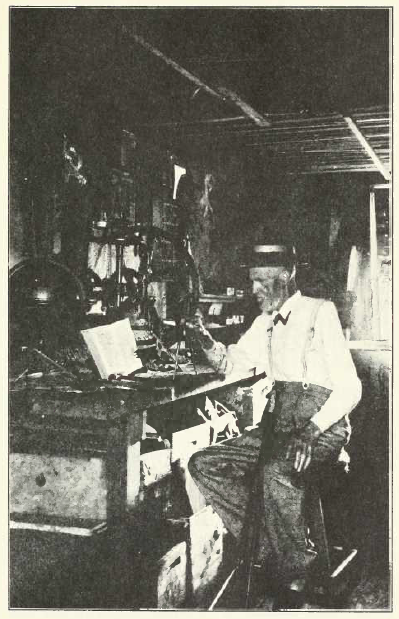 In 1902 Alice More Earle in her book Sun-Dials and Roses of Yesterday commented:
“Of course, there are in the United States many houses that manufacture optical and mathematical instruments and also make sun-dials. There are also those who make and sell very pretty brass dials, made to look well … regardless of the shape of the gnomon or drawing of the hour lines. I know no individual, however, save Captain Bailey, who makes accurate sun-dials for all latitudes.” [Fig. 1 of Captain John S. Bailey, 19th century dial maker - Earle].
Sundial makers are not just gnomonists, they are artisans, sculpting, cutting, hammering, and chiseling in bronze, brass, copper, steel, granite, flagstone, and slate. They form sundials from stained glass with came, create tiles in their kilns, invent new materials for sunlight sculptures and apply a variety of paints, stains, sealers and varnishes.
 In other words, sundials are made from just about any material. I have watched in awe the transformation of a block of metal into a fine gnomon as it is drilled, sawed, filed, and polished. There is the magic in the art of chemical etching: the ability to take computer generated drawings and transform them into resistant polymers by ultraviolet light from the sun that creates a protective shield over metal with just a trace of weakness, that when dipped into acid, leaves the etching of precise hour lines, elegant numerals and beautiful dial furniture artwork.
There are stone artisans that skillfully use mallet and chisel to cut stone, following chalked hour lines to create the grooves of hour lines and numerals. Mrs. Alfred Gatty in her famous Book of Sun-Dials first published in 1872 remarked about Scottish dials that
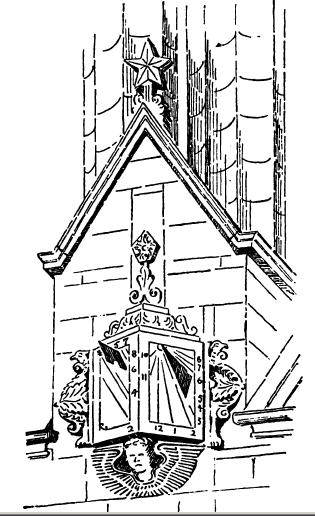
“Skilled masons of the seventeenth and eighteenth centuries have left their mark upon the walls of their houses at Newstead, near Melrose, in many curious little dials, tow-faced, three-faced, and in one case semi-cylindrical…” (p.144) [Fig. 2. Heriot Hospital Stone Dial by William Aytoun – Maister Maissoun at Heriot – Gatty]
Stone sundials makers are still at work today. In a recent news article from Inside Tuscon Business, [http://www.insidetucsonbusiness.com/ ] Alan Petrillo interviewed John Carmichael, who:
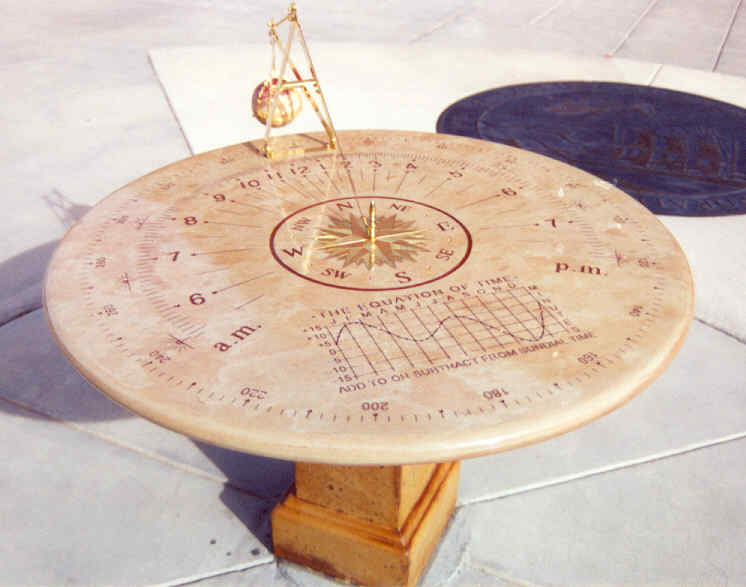 “characterized making sundials as ‘astronomy with applied mathematics. You need to know what the sun and planets are doing to conceptualize and understand the numbers.’ … For stone creations, Carmichael uses a flagstone slab weighing 150 pounds to cut a 26-inch-diameter sundial, which takes a couple of months to make. The finished sundial weighs about 80 pounds.” … “Carmichael has a love of carving stone, but admitted, ‘Stone has parts of the process that I don’t enjoy at all. The raw rock out of the quarry is heavy, and I have to get on my hands and knees to use a diamond cutter flushed by water to cut the stone. I get covered in mud, and sometimes it’s a chore to get it to a size I can work with.’ … [An] example of Carmichael’s work can be seen in Tohono Chul Park off West Ina Road, while his monumental sundials stand at the entrance to Innovation Corporate Center in Oro Valley.” [Fig. 3 Carmichael Flagstone Dial at Bullhead City – NASS #458]
Mrs. Gatty also commented on the materials used for sundials (Chapter IX), doing a bit of forensic research in accounting:
“From the frequent entries of payments ‘for a Diall’ in churchwardens’ accounts we may judge that there was hardly a church without one, and also that they did not last very long. Stone, wood, and paint are alike perishable, and metal might be stolen; but still the timekeeper was replaced up to the present century …”
Consider the advice from the National Bureau of Standards (now the National Institute of Science and Technology – NIST). In Circular No. 402, Sundials, prepared in 1933 by Prof. R.E. Gould, where he made recommendations for a simple horizontal dial:
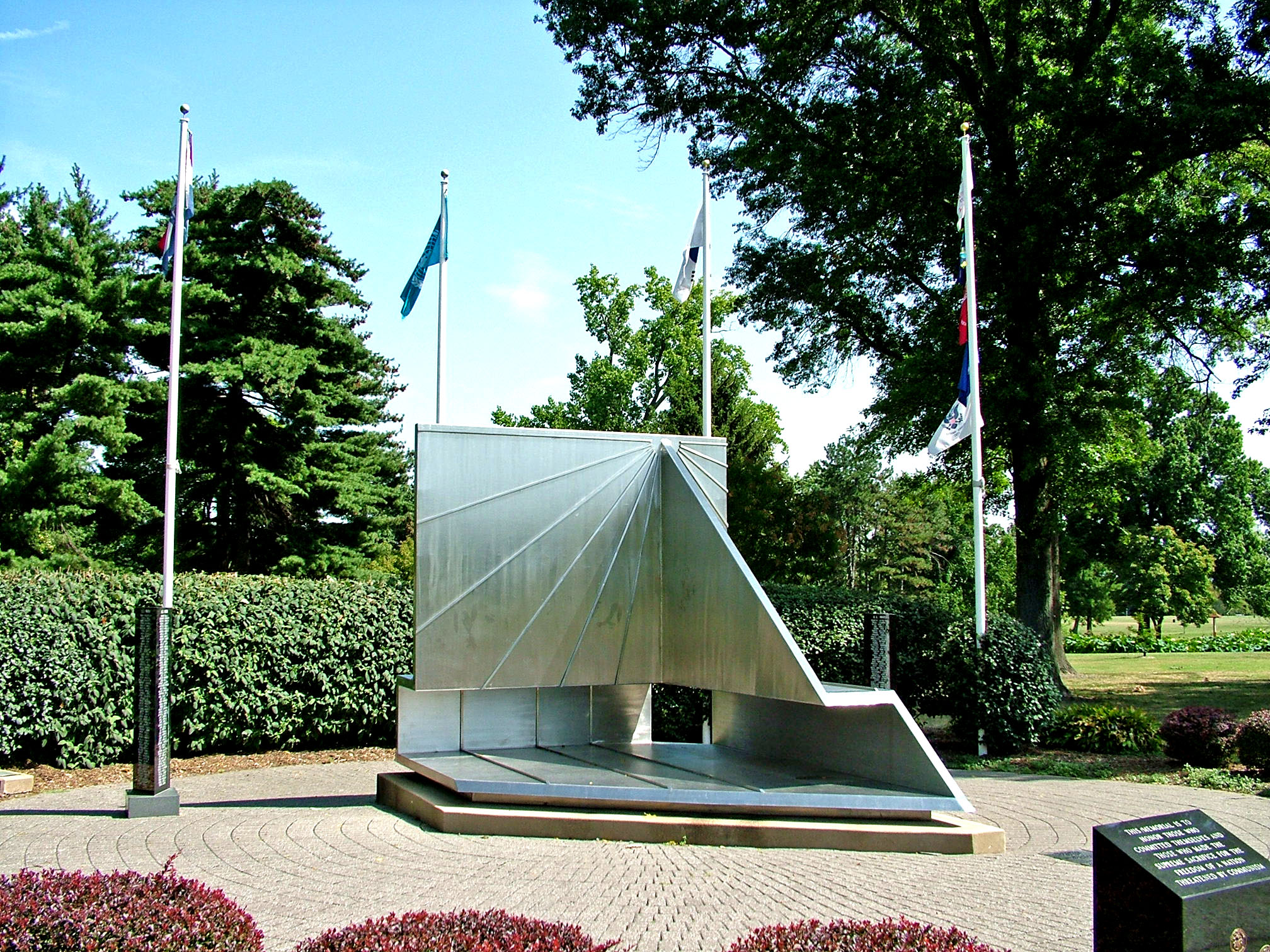 “In choosing the material on which to lay out the dial, consideration should be given to durability, resistance to weather, and legibility. A thickness of not less than one-quarter of an inch is recommended to assure rigidity of the surface. Bronze or gunmetal is generally used, and seems to be very satisfactory under the conditions to which sundials are exposed. Stainless steel stands up well and is not subject to marked discoloration. A plate of optical glass about one inch thick with etched lines might serve very well, but is subject to breakage and chipping. Copper, aluminum, brass, silver, German silver, and most of the other common metals are subject to tarnish or oxidation, and in a short time the lines become indistinct. Iron rusts too easily to make a good sundial material. The use of chromium plate on a base of some of the metals mentioned might make a very good dial material. [Note: bright metals do not show shadows well as demonstrated by the beautiful stainless steel dial in Fig. 4, the Korean War Memorial Sundial at St. Louis Forest Park, MO – NASS #54]
“To avoid any possibility of electrolysis, the gnomon and any screws making contact with the dial should be of the same material as the dial.
“A good concrete or stone foundation on a firm base makes the most satisfactory means of assuring stability of mounting. The pedestal upon which the dial is to be mounted must be secured to this foundation in a manner to make it perfectly rigid. Materials for the pedestal must be durable and firm. Concrete, marble, stone, or brick make very good pedestals. Wood is not suitable for either the pedestal or the dial because of likelihood of distortion and decay.”
What is your favorite material for making sundials? I must confess that I prefer paper dials since children can quickly cut them out and assemble them. And once again NASS and the Analemma Society will be presenting cut-out dials and sundial information to students, parents and teachers at the USA Science and Engineering Festival (USASEF) held in Washington Convention Center, Washington D.C. April 25-27, 2014. Sundials – World’s Oldest Clocks
- Details
- Hits: 18339
Banneker - Drawing a Sundial
By Robert L. Kellogg, Ph. D.
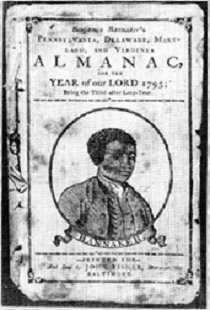
Benjamin Banneker, 1731-1806 , is one of the nation's best-known African American inventors. He was born in Maryland and in 1791 played an important part in surveying the newly designed Federal Territory, now called the District of Columbia. In his youth, Banneker was inspired to build his own clock after an acquaintance gave him a watch. He took the watch apart to find out how it worked and made drawings of each component, and based on his drawings, he carved larger versions of the components out of wood and constructed a clock that kept accurate time for more than 50 years. As mathematician, he designed an Almanac that was a rival of Benjamin Franklin’s famous publication.
As astronomer, clockmaker, and mathematician, he was expected to know how to design sundials, although none exist bearing his mark. In an age before pocket calculators, how would Banneker design a sundial? The graphical method is available in modern texts such as Waugh’s 1973 classic “Sundials: Theory and Construction”. Want to lay out a horizontal sundial without sines, cosines, and tangents? Then this “Sundials for Starters” is for you.
- Details
- Hits: 13906
Laser Trigon
Mechanical Dialing and a Laser Trigon
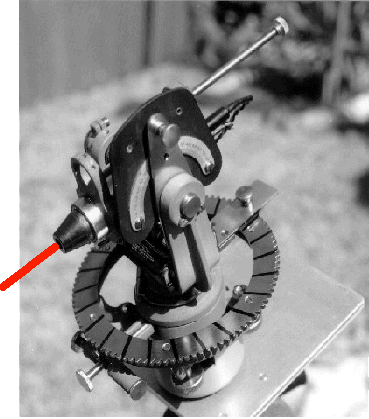 By Robert Terwilliger
The most popular ways to lay out sundials involves computation, geometry, or a combination of both. These methods assume the dial will be created on a regular surface, such as flat horizontal or vertical dials or circularly curved equatorial dials.
A less known method is mechanically drawing dial lines using a string or laser beam to project artificial “sunbeams” to show where light and shadow fall. This technique can be used on both regular and irregular surfaces. We start by describing the principles of a trigon.
- Details
- Hits: 13402