
Arc of Memory
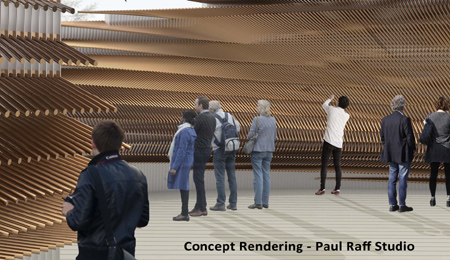 A memorial, the Arc of Memory, will be completed in 2018 on the west side of the Garden of Provinces and Territories in Ottawa. The design by Paul Raff's Sutdio is a "living calendar". Raff described the memorial as a way to “honour the 8 million Canadians that can trace their origins to countries that suffered oppressive regimes of communism by creating an instrument of memory.” In essence Raff is designing a huge digital sundial (or as he calls it, a "three dimensional calendar"). According to Erin Dommely of Azure Magazine, the memorial is constructed of two curving walls 4 x 21 meters containing 4,000 short bronze rods arranged in 12 dense rows across a series of 365 stainless steel fins. Erin describes the Arc of Memory's principle of having each rod uniquely angled towards the sun, whereby each hour of the day is illuminated each day of the year.
The two walls are split at the winter solstice and "On the darkest day of the year the design would invite visitors to step through in a metaphorical journey from darkness and oppression to lightness and liberty.”
Read more at: http://www.azuremagazine.com/article/memorial-victims-communism-design-revealed-ottawa/
- Details
- Hits: 12655
Rochester Bicentennial Sundial
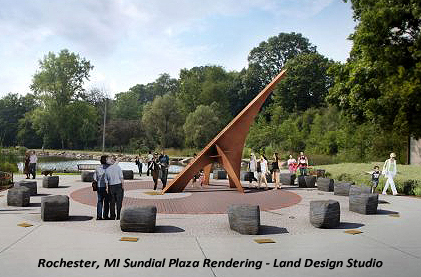 Rochester, Michigan was settled in 1817 and is now celebrating its Golden Centennial with a sundial. The city is on the northern outskirts of Detroit, with more than thirteen thousand citizens. According to Natalie Broda, Rochester City Council approved $190,000 for the sundial, but the cost of the project is expected to exceed that due to the unstable, uncompacted ground that the heavy monument will sit on." The dial will be unveilled as part of the bicentennial homecoming envent scheduled for August 12, 2017.
Broda continues,""The sundial is the brainchild of Rochester’s city beautiful commission, which had been mulling the project over for several years according to Nik Banda, deputy city manager. The project was chosen after a request for proposals was sent out from city council." The sundial design was done by Russell Thayer, a sculpture artist from Franklin, Michigan.
The 20-foot tall gnomon of triangular cross section will be constructed with weathering steel, otherwise known as corten steel. Broda notes that this material was chosen to pay homage to the steel used throughout the old knitting mills of historic Rochester.
aewinc.com describes the surrounding hour marks as part of "Twenty stones [each weighing over 1000 pounds] within and surrounding the plaza have been carefully sited to celebrate twenty decades of history. The decorative stones are indigenous to Michigan and have colors that complement the gnomon; they will serve as both seating and focal elements, as well as [hourly] time markers for the sundial. Historic plaques will be placed on the stones highlighting historic events which occurred during each of the twenty decades." To increase the historical retrospective, reclaimed 100-year old bricks from historic Main Street buildings will be used to complete the circular plaza around the sundial monument.
- Details
- Hits: 12324
Washington Monument Sundial
Today it is snowing in Washington DC and it brings to mind a winter some 43 years ago when the Washington Monument was turned into a sundial. Over the years many have proposed turning this spiring monument into a sundial. For example at the first North American Sundial Society (NASS) Conference in 1995 Robert Terwilliger drew a map of the shadow's excursion from Independence Avenue to E Street NW, repeated here at left. In June 2011 in the NASS Quarterly Journal The Compendium Robert Kellogg suggested that "...the precise shadow lines drawn in [Terwilliger's map] are precise geometrical constructs. The problem is the sun is not a point source, but a disk about 1/2 degree in diameter. The result is the sun casts a penumbral (partial) shadow when it is partially obscured, resulting in a range of light to dark sunlight that blurs the edges of shadow, making a gradient from light to dark.
To get a feeling for the impact of the penumbral shadow from the Washington Monument, we start with a brief summary of the Monument: A competition was held in 1836 and won by architect Robert Mills who designed a tall obelisk. Excavation began in early 1848 and the cornerstone was laid as part of the 4th of July ceremony by the Freemasons. Lack of funds created a hiatus in construction in 1858, and finally the capstone to create a pyramidal point to the obelisk was laid December 6th, 1884. The obelisk as we see it today is 169.29 meters tall, 16.8 meters wide at the base and 10.5 meters wide at the start of the capstone pyramid. The pyramid itself is 17m tall, with a small aluminum capstone at the tip and by the time the sun is sufficiently blocked by the top of the oblesk for us to see the shadow, the sun is well below the tip.
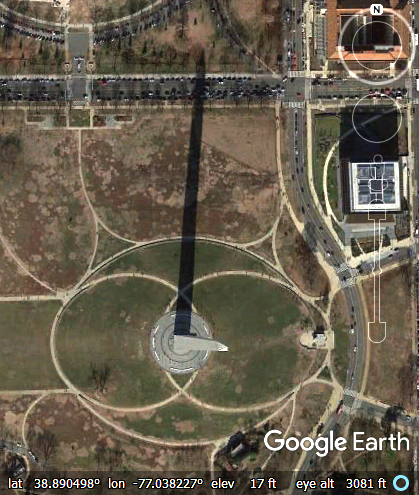 In The Atlantic on-line issue of May 23, 2014 Robinson Meyer found that the Washington Monument captured the imagination of Google Map engineers: "Ken Norton, a partner in Google Ventures, reports that the digital shadow has reflected the real shadow’s position for about three years. [now, 6 years] It’s a fun accent, possible only with the kind of live, dynamic map that Google deploys...Google didn’t need to add the monument’s shadow, but it did, as a kind of homage to the world’s hidden-in-plain-sight details. Of course, Google’s unknown mapmaker wasn’t the first to notice the monument’s shadow. 'As an artist, one of the things that I do...and I think most artists traditionally have done...is point out things people don’t see.' ”
Which brings us back to the snowing day 43 years ago on February 11, 1974 when Yuri Schwebler decided to turn the Washington Monument into a sundial. In her article Meyer continues: "He was, by day, a newspaper layout designer...[but] before Google made its sundial for the screen, Schwebler turned the monument into a real (gigantic!) one in the winter of 1974:"
Schwebler said, "One day I realized I’d never seen the shadow of the Washington Monument because it’s so huge. And then one day I looked for it, and I saw it, and it moved. I was at the end of the shadow, and it moves about four feet every minute." His materials for such a transformation? According to CBS, $24, six feet of snow, and a plow on loan from the National Park Service. During the report, Schwebler, who died in 1990, is asked why he turned the monument into a sundial at all. His answer? "You can actually see the Earth move, or feel it move, by watching that shadow."
Click on the video above or watch it on YouTube at https://www.youtube.com/watch?v=_M5WXcVsfIk to see Walter Cronkite of CBS news report on the Washington Monument as a giant sundial.
- Details
- Hits: 22656
Campbell University Sundial Commemorate
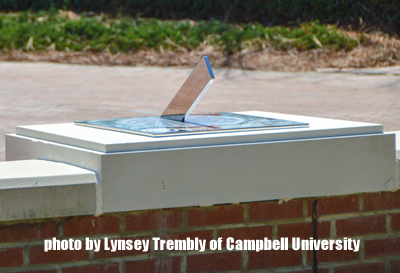 Mathematics professor Jerry Duncan Taylor passed away in 2013, but his 46 years of teaching lives on at Campbell University in Buies Creek North Carolina just south of Raleigh. A commemorative sundial in front of Taylor-Bott Rogers Fine Arts Building was dedicated on Wednesday, March 21, 2016.
The highly polished dial, approximately 12 inches square, with an inclined bar gnomon sits on a plinth embedded in a low brick wall for all to see. There are time marks for every 10 minutes, with standard time given as Roman numerals and daylight savings time one hour later given in larger Arabic numbers.
Professor and mathematics department chair Meredith Williams recalled the start of his teaching career at Campbell: "I'm not sure I would have made it through my first semester without Dr. Taylor. I had an extremely challenging group of students in a class who were determined to see how hard they could push the new professor. Dr. Taylor always had an encouraging word for me before I went to class."
Rachel Davis quoted Provost Mark Hammond from the sundial dedication (http://www.campbell.edu/news/item/sundial-dedicated-to-late-math-professor) "We wanted something physical that we could see, celebrate, and reflect on him and the good man that he is and the way he has touched many of the people here... [his] very inspired spouse, Louise Taylor, thought that perhaps we could memorialize Jerry through a sundial. It gives us the time to pause and reflect and think about Jerry."
- Details
- Hits: 10998
Southern Arkansas University Dedicates Sundial
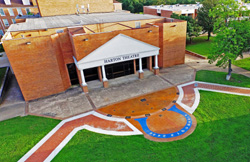
The large analemmatic sundial in front of the Harton Theater North Entrance of Southern Arkansas University (SAU) is being formally dedicated on Thursday, November 5th, 2016 in memory of the late David Thomas Smith, a 1957 SAU alum and retired assistant director of the SAU Physical Plant.
The Smith Sundial, funded by family and friends of David Smith was built by the SAU Department of Art and Design and engineers of the SAU Physical Plant. Patrick Finney was the construction supervisor and Steven Ochs was the project concrete art designer and craftsman. As described in the NASS Sundial Registry, Dial #800 is "a 22 by 17 foot analemmatic dial of stained concrete with Arabic hour numerals of polished brass. The dial perimeter and hour numerals are set in a blue decorative polymer "U" arc, appearing as a large mule shoe that represents the university Muleriders mascot symbol. Dial colors represent the royal blue and gold school colors."
As reported by Southern Arkansas University, "The Smith Sundial at SAU is one of only four Arkansas sundials that are registered on the North American Sundial Society, and the only one outside of Little Rock and North Little Rock. It is also the only sundial in the state that is [a monumental] analemmatic..."
Read more at: https://web.saumag.edu/news/2015/10/28/sau-to-dedicate-smith-sundial-on-nov-5/
- Details
- Hits: 14878
9/11 Timeless Sundial Dedicated In Hampton, N.J.
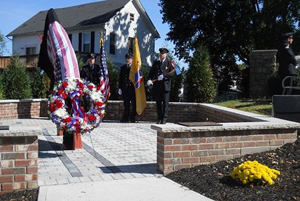 Tom Carpenter, a member of the Hampton fire company for 44 years, presented plans for a 9/11 memorial to the Borough Council at the beginning of 2012 and Councilman James Cregar began designing the memorial as a sundial using beams recovered from Ground Zero of the Twin Towers.
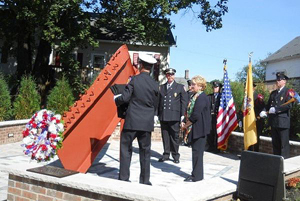
Last Saturday the beams, which had been transformed into a timeless sundial, was dedicated in a ceremony “… to the innocent victims of the attack on our country on September 11, 2001 and to all those who suffered responding to it. By the Citizens of Hampton 9/11/2012”
Fire Company President Rob Walton, also a county Freeholder, served as master of ceremonies at the dedication. Joining the volunteer firefighters were members of the Hampton Emergency Squad, some of whom went to Ground Zero immediately after the 9/11 Twin Towers attacks. Georgia Cudina of Lebanon Township assisted with the draping of the U.S. flag over the beam gnomon in memory of those who died, including her husband Richard who was among the many 2001 victims.
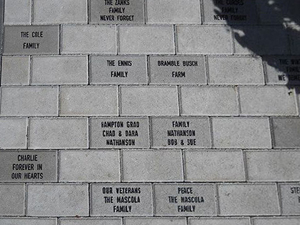 Walton explained to an audience that overflowed into the nearby street that two bent pieces of steel from one of the towers make up the gnomon of the timeless sundial. Surrounding the gnomon there are no hour lines. Rather, the dial base, shaped into a large Pentagon, has a floor of light and dark brick pavers creating the outline of the Twin Towers and the number 93 for the airline flight that crashed in Shanksville, Pennsylvania. Within the outline of the Twin Towers are pavers with engraved names and remembrances. Four plaques on the memorial wall catch the morning gnomon shadows to remember that infamous day’s events:
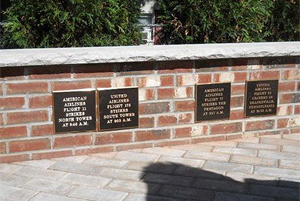 Keynote speaker Congressman Leonard Lance of Clinton Township noted that more than 700 New Jersey residents lost their lives in the 9/11 attack. And Rob Walton said that the memorial should remind us all “to treasure time.”
Thanks to Tom Carpenter, Mayor James Cregar, Rob Walton, Rick Allen, and the committee of volunteers who worked so hard to create the memorial. You can read about the dedication in Terry Wright’s article from the on-line Hunterdon-County-Democrat that includes many pictures of the dial and the ceremony. Visit http://www.nj.com/hunterdon-county-democrat/index.ssf/2013/09/911_sun_dial_memorial_dediated.html
To raise funds, engraved bricks with names or short messages from the donors are still available - for details contact Tom Carpenter at 908-537-4521.
- Details
- Hits: 15168